
This blog post is a summary of the journal article,
“The impact of life-long strength versus endurance training on muscle fiber morphology and phenotype composition in older men”.
70+ year olds with power, strength, and muscle mass of 25 year olds? Read on!
If you would like to go straight to the takeaways, click HERE.
The age related decline of muscle power, muscle strength, and muscle mass has been well documented. What begins as losing a few yards on the golf course and not being able to run up the stairs quite as quickly can end up as a much more serious matter as time without intervention passes by.
A decline is ultimately unavoidable, but there are things we can do significantly slow, and even reverse this trend for a certain amount of time.
In an ideal scenario we want to build as big a buffer as possible in these crucial functional qualities, and then fight like hell to maintain them day after day.
Hope is not lost if you are only getting serious about your physical conditioning later in life. Life changing alterations in your physical function, and how it projects for upcoming years can be made well into our senior years.
Subjects
This research study recruited a total of 42 male subjects and split them into 4 groups.
The “senior” subjects were split into 3 groups, and there was one group of young people.
The author notes they did also try to recruit female subjects, but could not find strength trained masters female athletes in the locality.
Group 1) 10 strength trained masters athletes with an average of 73 (+/- 4 years).
These subjects were recruited from local powerlifting and olympic style weightlifting clubs.
It is important to note these are not 73 year olds that just go to the gym and include weight training in their routine. They are actively training for strength sports, so it is safe to assume they are very focused on trying to progressively add more weight to their training exercises and training with a high effort level.
Powerlifting is the sum of the most weight that can be lifted for one repetition in the squat, bench press, and deadlift. Weightlifting (which in this case refers to the sport of olympic weightlifting) is the sum of the most weight that can be successfully lifted in the snatch and clean and jerk. These are very “explosive” exercises.
A variety of other assistance exercises are used in training.
Group 2) 8 endurance trained masters athletes with an average age of 72 (+/- 6 years).
These subjects were recruited from local track and field clubs.
Only subjects who competed in running events of 3000 meters or longer were included.
Group 3) 13 recreationally active seniors with an average age of 75 (+/- 6 years). These subjects engaged in activities like hiking and skiing but were not in training for a particular activity.
Group 4) 11 moderately active young people with an average age of 25 (+/- 4 years).
“Participants were considered athletes if they had been actively training and competing over the past 2 years in their respective sport. Both the strength and endurance master athletes had trained systematically most of their lives, but reported some sporadic breaks throughout their careers”.

Tests
Strength: One repetition maximum (1RM), which is the most weight that can be successfully lifted for one rep was assessed on an instrumented leg press.
Rate of Force Development (RFD): This was also conducted on the instrumented leg press. Rate of force development measures how much force a subject can produce within certain time parameters. It is commonly referred to as a measure of “power” or “explosiveness”.
For this test the leg press was loaded to the same amount as the subjects body mass. The subjects lowered the weight under control, paused for one second, and were then encouraged to perform the upward phase of the lift as quickly as possible.
Rate of force development is important because in many daily activities and sporting actions the movements are too short in duration to apply maximum force (strength). When this is the case, how quickly we can produce a certain amount of force is important.
While there is very often a relationship between the two measures, subjects with the same strength levels can have different RFD capabilities.
As a general rule of thumb, in activities where the goal of the activity is not to move the most weight possible, but instead to move a light weight very fast (think golf swing), or react to a certain event (think catching yourself after losing your balance or a misstep), RFD starts to become very important.
VO2 Max: This was done on a treadmill of gradually increasing speeds, until the subject could no longer progress. The subject is connected to an apparatus that measures their maximal oxygen uptake. VO2 max is commonly described as the gold standard in objectively assessing a person’s aerobic capacity.
Muscle Biopsy Sampling (Fiber Type Proportions): A section of muscle tissue was removed from the thigh (vastus lateralis) of each of the participants. This allows the researchers to investigate the proportion and size of the different muscle fiber types in each of the subjects. If you have read some of my other articles you will be familiar with different muscle fiber types. If not, you can read this article.
Results
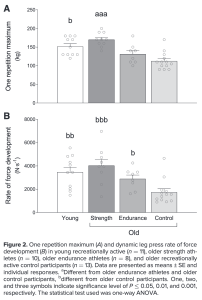
Strength: The strength trained masters athletes had the highest leg press 1RM. Next was the young group, then the endurance trained masters athletes, and finally the recreationally active seniors.
Rate of Force Development (RFD): In the RFD test on the dynamic leg press the strength trained masters athletes were slightly better than the young group.The young group was slightly better than the endurance trained masters group, which was better than the recreationally active seniors group.
A results table can be seen below.
VO2 Max:The moderately active young group had by far the highest VO2 max values.
The endurance trained masters athletes were next up, and then the strength trained masters athlete, and recreationally active seniors. There was no meaningful difference between these two groups.
This highlights the difficulty of maintaining VO2 max with age. It also shows that strength training does not do much for VO2 max in the long term.
| Group | VO2 Max mL·kg1·min1 |
| Young | 63.1 +/- 6.6 |
| Endurance Trained Masters Athletes | 47.5 +/- 8.1 |
| Strength Trained Masters Athletes | 33.2 +/- 6.8 |
| Recreationally Active Seniors | 35.2 +/- 3.8 |
Muscle Biopsy Sampling (Fiber Type Proportions): Strength trained masters athletes and the young group had the highest proportion of type 2 (fast twitch) fibers, and there was no significant difference between these two groups.
| Group | Type 1 | Type 2a | Type 2x |
| Young Moderately Active | 49.9 +/- 14.4 | 41.9 +/- 9.8 | 9.3 +/- 8.9 |
| Endurance Trained Masters Athletes | 60.7 +/- 11.9 | 33.5 +/- 6.5 | 5.9 +/- 5.8 |
| Strength Trained Masters Athletes | 48.1 +/- 16.4 | 41.4 +/- 9.2 | 10.5 +/- 12.9 |
| Recreationally Active Seniors | 65.0 +/- 12.4 | 29.7 +/- 11 | 5.3 +/- 7.3 |
It has been reported in other studies that the loss of muscle mass as we age is entirely a fast twitch fiber problem. As we age, we lose size, number, and function of fast twitch fibers, but not slow twitch fibers. In fact, some fast twitch fibers become denervated and replaced by slow twitch fibers.(1).
This is also seen in this paper, with the recreationally active seniors having the highest proportion of type 1 (slow twitch) fibers (65%) and the lowest proportion of type 2 (fast twitch) fibers (35%)..
There are clear differences between the strength trained masters athletes and endurance trained masters athletes, as can be seen in the table above. This is not surprising from the vast differences in their training routines.
Some of the difference might be genetic, as people may be more inclined to stick with sports they have better genetics for.
Takeaways
-Strength trained masters athletes with average age of 73 (+/- 6) had higher maximum strength and rate of force development (a proxy for “explosiveness”) than moderately active college students with an average age of 25 (+/- 4). Their training also preserved their fast twitch muscle fibers, which was not the case in endurance trained masters athletes or moderately active seniors. The authors note that the strength trained masters athletes had strength and RFD levels 30-294% higher than their age matched counterparts.
-While not as effective as strength training, the endurance trained masters athletes had higher maximum strength and rate of force development levels than the recreationally active seniors.
Some of this may be due to the fact that these athletes main focus was distance running, half of them also included some basic resistance training in their routines, and most distance runners also include some faster paced interval running in their training. The training for distance running certainly exposes our legs to higher force activities than what would be experienced by the recreationally active group.
-VO2 max (a measure of aerobic fitness), was by far the highest in the young group, even though they were not endurance athletes. This goes to show the difficulty of maintaining aerobic fitness as we age, and why it needs to have a place in your training plan for all around long term health & fitness. VO2 max is a very strong predictor of long term health & life expectancy. (Not because there is anything inherently special about VO2 max, it’s just a way of measuring aerobic performance).
The endurance trained masters group had a higher VO2 max than the strength trained masters group. There was little difference between the strength trained masters group and the recreationally active seniors.
Your training plan must include…
1) Strength training with a high effort level. Ideally with heavy weights relative to your strength level, and explosive intent. This will allow you to maintain / improve your strength, rate of force development, and fast twitch fiber size and function.
Endurance training and being generally active will not be sufficient for this. Neither will just “exercising” with weights. There needs to be a high effort level, ideally with a structured program where you focus on incremental overload (more load & more speed).
Adding some light and fast exercises is also beneficial for improving your explosive qualities.
e.g short sprints on foot or a stationary bike, jumps, med ball throws and slams, lifting light weights at maximum speed.
2) Cardiovascular training. Strength training or just being active in general will lead to a server decline in your aerobic fitness over time, compared to if you engage in endurance training.
You need to spend a considerable amount of time with your heart rate elevated. A mix of longer duration and steady state exercise is best. You can choose any modality of exercise you like, and it’s perfectly fine to vary it.
The training programs on the Fit For Golf App completely take care of point #1. Almost all of those programs are 3 days per week. The days in between these workouts is the perfect time to do your cardio / aerobic work.
How you structure your cardio work will depend on how much time you are willing to allocate for it, but you should have a mix of moderate intensity cardio where you are working reasonably hard, but could still have a little bit of conversation. Around 30-60 mins works great for this, but anything is better than nothing.
You should also have some higher intensity efforts of shorter duration where you try to work at your maximum intensity. For example, after getting warmed-up for 5-10 mins, you work very hard for 2-3 minutes, then go very easy for 2-3 minutes, and repeat for a few sets.
Age is certainly not “just a number”, but how athletically you age is largely up to you.
Link to reviewed journal article:
https://journals.physiology.org
Other references:
1) https://physoc.onlinelibrary.wiley.com