
Training for more swing speed is only effective when the sessions are high-quality. Many golfers don’t see progress simply because they make avoidable mistakes in how they structure or approach their speed work. Small details like timing, readiness, warm-up quality, and session design make a big difference in how fast you can actually swing.
Before getting into the specific mistakes, it’s important to have a basic understanding of what effective speed training looks like. If you haven’t already, make sure to read Swing Speed Training – The Fit For Golf Guide, which lays out the foundational principles that this article builds on.
With that groundwork in place, let’s look at some of the most common speed training mistakes that golfers make, and how you can avoid them.
1. Not prioritizing speed training
Our ability to produce high outputs in speed & power activities is very sensitive to fatigue. Fatigue in this sense is not how we feel, but an actual decrement in our force production capabilities. There can be a number of physiological factors behind this fatigue.
If we are serious about improving our club head speed, we must try our best to be in a good state of readiness for our speed training sessions.
When scheduling your week, it is important to try and plan your speed training sessions for when you will be physically and mentally ready, giving yourself the best chance of a productive session.
This isn’t always easy for busy people, but it does make a big difference. Don’t expect a Monday morning speed session to go well if you’ve had a tiring weekend and are low on sleep and energy.
There is no “best” time for speed training, and the most important factor is that you find consistency in getting it in 1-3 x week, but if it’s an important goal for you, try to ensure you are reasonably fresh.
2. Insufficient warm-up
There is a huge difference in our physical capabilities when fully warmed up, versus “cold’. The term “warm-up” is very broad. Without getting too technical, I would prefer for you to think of this period as “priming”. We are trying to get our body into a state that enables us to perform at our maximum capability in that particular session. This pre activity priming will also help us reduce the likelihood of injury.
The golf swing is a fast, elastic activity, requiring a large range of motion, and immense coordination to perform at a high level.
Our warm-up (priming) needs to be specific to this. For example, while we would “warm up”, it would not make much sense to briskly walk or ride a stationary bike and do some static stretches, then immediately try to swing a golf club as fast as we can. We would not be adequately prepared.
We can absolutely have a general phase to our warm-up, but it is far more important to gradually “work through the gears” in the golf swing motion, going from low intensity to high intensity effort.
This is an important time for the body to get prepared for the swings to come, but is also a very useful time to rehearse and exaggerate the movements we want to use when training. Think of not just warming the body up, but also prepping the brain and sharpening our coordination.
As a general rule of thumb, you should be taking at least 10 minutes, and ideally more like 15 minutes, before trying to swing as fast as you can.
Yes, I know you are limited on time, but I would prefer to see you remove “session time” then warm-up time. A good warm-up really enhances the quality of the session, and greatly reduces the likelihood of injury.
I have heard so many stories of people getting injured in various workouts because they were short on time and either skimped through or totally skipped the warm up.
I perform Dynamic Warm-Up #1 from the Fit For Golf App before every session, and also make sure to perform at least 10+ swings gradually ramping up the effort.
Here is an example of what I do after the Dynamic Warm-Up before getting into the hitting session.
View this post on Instagram
3. Under appreciating the role of technique
Most golfers who start speed training gain speed rapidly. 5 mph in the space of a few weeks is quite common (and this is great, that’s potentially 12 yards!). These improvements are due to a number of factors like getting more comfortable swinging at a high effort level, improving the ability to recruit fast twitch muscle fibers, and changes to coordination / technique that arise as a result of trying to maximise speed.
Unfortunately, many of these golfers hit a wall after a couple of months of training and end up spinning their wheels in terms of speed gain. They continue working consistently with a high effort level, but see very little in return.
In these scenarios I think it is critical for golfers to learn about their swing technique, and see how well or not it is supporting their goal of swinging faster.
It is very hard to overpower poor mechanics with “trying harder”. The vast majority of us are capable of much more speed than we express, due to deficiencies in our technique.
Perhaps the most valuable thing I have done for my speed training (and swing in general) over the last few years is to take videos during sessions. I keep a video or two from each session that I can look back on, always add a note to the videos about what the speed was, and what “the feel” for the swing was. It is amazing how different what we think we are doing can be to what we are actually doing, and this feedback can be invaluable. There have been countless sessions where I have increased speed by 2-3mph in the session by reviewing a video and noticing something in my technique (it’s always the same habits).
While you may not be the best person to analyze your swing mechanics, once you have videos, there are exceptionally good coaches available through the Skillest App and various other platforms. Tre Mullins, Jayson Nickol, Ryan Mouque, Drew Cooper, Steve Furlonger, Erik Barzeski, are all coaches offering video analysis, that will absolutely help you.
*Make sure to get proper face on and down the line camera angles. You will need a tripod for your phone.
Use the grid lines on your camera and alignment sticks to ensure you get the camera angles you are looking for when filming your swing.
The alignment stick on the mat should be directly under where your hands will be.
Stick should be running parallel to vertical grid lines. pic.twitter.com/puyYNLv2OL
— Fit For Golf – Mike Carroll (@Fit_For_Golf) November 22, 2022
While speed training does tend to organically improve swing technique, it is highly likely you won’t just stumble onto the most effective technique without some expert guidance. There will come a time when improving your technique will probably be more important than all out speed sessions. It is not uncommon to swing faster than before while trying less, with better technique. Just beware, it can be challenging to change technique, but is usually worth it. Especially if you are a regular golfer. If you are a tour pro reading this, you need to be more careful with changing your technique for more speed, but you probably already know that!

4. Lack of long term training organisation
Your training should not look the same all year round. Once we get past the beginner and intermediate stages in training, it gets very difficult, to improve a wide variety of physical qualities at once. You’re probably not going to be able to maximise hypertrophy, strength, speed, aerobic fitness, body composition etc all at the same time.
When training to maximise club head speed, we need to think in terms of short term versus long term gains. How we would train to improve club head speed the most in six weeks is not the same as how we would train to improve it the most in 2 years.
There is the swing part of the equation (mechanics and speed training), and there is also the physical development side of the equation. They of course merge a little bit, but there are also distinct differences.
Depending on your training background, physical profile, and swing mechanics, your biggest needle mover might be different to someone else’s.
Most people, especially the recreational golfer, need a blend of everything. They need to work on comprehensively improving their physical capabilities especially in terms of muscle power, their swing mechanics, and learning how to get comfortable and coordinated swinging fast!
It can be very difficult to know how to ogranise your training for long term progress. This is why the primary programs on the Fit For Golf App break the training year / season up into different phases, with each phase prioritizing a different physical quality that is important for long term success. It is also very psychologically stimulating to get some training variety, increasing enjoyment, adherence, and effort levels, generally speaking.
The Mass, Force, Velocity, and In Season programs, are designed to be done in a sequential fashion with one program setting you up for the next. This could be run year after year, trying to step up your performance in each program every time you come back to it. This is the training structure I am currently following.
The great news about these training programs is that they also cover the resistance training elements that are absolutely critical to longevity, health, and “aging athletically”. They are not just designed for club head speed. They are designed to keep you muscular, strong, powerful, and fast for both golf and life!
5. The comfort zone & overspeed training
While I think the majority of the focus for your speed training should be on physical development and swing mechanics in the long term, there is no question that a percentage of your overall training should simply be practicing swinging absolutely 100% as fast as you can. Faster than you feel comfortable with, faster than you can “control” and faster than you would ever swing on the golf course. This has become commonly known as overspeed training.
This provides a valuable stimulus for the central nervous system, muscles, and tendons, and can also be quite important psychologically. I also think that in general, it tends to be good for our technique.
What we are capable of and what we think we are capable of are quite different. Without stretching the limits, and truly pushing as hard as we can we will never know how far we can get. This is the same across all training modalities.
Every single player or long drive competitor I know or have talked to that has gained considerable speed has had this as an element of their training.
You are simply exploring and figuring out ways to move the club head faster. As we practice this more and more, we tend to organise our movement more efficiently, and become better at coordinating these maximum speeds. At first you might feel out of control, lose balance, and really struggle with strike and ball flight (if using a ball), but over time you adapt and get better at it.
Remember the goal is the maximise club head speed. You may find that this doesn’t occur at maximum effort level. Sometimes trying too hard can lead to too much tension, and inefficient technique. This is all part of the explortation process. “What feels lead to the fastest swings for me?”
It is amazing how slow your original speed can feel after doing this and how easy it is to add a few mph to what was your previous “cruising speed”. In a sense, it recalibrates what we think fast is. You might realise you were leaving a huge amount in reserve.
Remember the goal of overspeed training is to make your “useable speed” or your “golf swing speed” faster. It is a training tool.
Learn how to create more speed, allow the body adapt to these higher speeds, then absolutely dial it back to what feels comfortable and in control. You will probably notice that this “crusing speed” is now much higher than would have felt comfortable if you had never forced your body to become accustomed to a higher speed and more potent stimulus.
Here is a great video of two time US Open Champion Bryson DeChambeau using this training method.
Bryson trains himself to go well over 200mph ball speed and 135mph club head speed in training, and then dials it back a little bit on the course to get the balance of distance and accuracy he is looking for. He averaged 192mph ball speed and 128mph club head speed in his recent US Open victory. As a frame of reference, PGA TOUR average is 174mph ball speed and 116mph club head speed.
For this type of training I am a huge fan of The Stack System. I am also an ambassador of the company. You can get 10% off The Stack with the code FFG24.
For best long term results I recommend a combination of The Stack system, and driver and ball training. There are various ways you can organise this, but in general, if using both, The Stack should be used more in the off season and less during the competitive season. Use it to really ramp up your swing speed, then dial in your skill with driver and ball coming closer to competitive time. You can keep them both in your training plan year round, and simply adjust how much of each you do.
6. Dismissing the recovery process
Recovery is part of the training process. To make progress you must stimulate the body with a training stressor. This stressor generally leads to some fatigue. While recovering from this fatigue, your body is also trying to create adaptations in the central nervous system, muscle, tendon, and other connective tissue in a way that makes it better equipped to deal with this stressor in future.
If we try to perform another training session of the same type before we have recovered from this fatigue and before this adaptation has occurred, we will not be getting the most out of the training session.
It is very tempting to want to do more and try harder when in the search of progress. Sometimes this is counter productive, as the person is never actually fresh for a training session, and therefore cannot push their body maximally.
For example, one of the things that happens in a response to challenging resistance training (and high volume speed training) workouts is muscle damage to the fast twitch muscle fibers. These are the ones we are trying to train when we are speed training. When these muscle fibers are damaged we cannot recruit and therefore train them as well as when they are not damaged.
You can generally tell when you are fatigued in a speed training session by monitoring the speeds on your speed radar. If you go through your full warm-up, get into the session, and notice that speeds are significantly reduced compared to normal, fatigue is likely a key factor. The “certify warm-up” feature in The Stack System app is a fantastic tool for this. You should definitely use it if you train with The Stack.
Whether to keep going or end these sessions is a common question and it is a tough one to get right. You’re almost certainly not going to set any PB’s in this session, and pushing as hard as you can might just delay the recovery process by incurring more fatigue, but a poor stimulus for adaptation.
In these scenarios I generally don’t push it, and instead focus more on whatever technique element I am working on. There’s nothing more frustrating than trying as hard as you can in a speed training session and seeing numbers that are well below your norm. This is going to happen on occasion however. Physiology is hard to predict.
If you are any more than 5% below normal speeds, I think it would be wise to save maximum effort for another day, and use the session to focus on your movement pattern.
As you get more advanced in training and progress is harder to come by, structuring your training week to ensure there is adequate recovery before an important session is crucial.
There are many supplements and hacks touted as improving recovery, but none of them are particularly effective, and some of them improve recovery time by blunting the body’s response to the stressor, and therefore adaptation. Sleep, nutrition, managing life stress, and our physical conditioning are all we can really control for recovery times. Regardless of how good these things are however, there is a minimum amount of time it is going to take, and you can’t speed it up.
If you have been on a long speed training plateau, and are training “hard”, I would try doing less for a few weeks and seeing how you get on. In general, I like to see 48 hours between a strength training workout and the next speed training session to provide sufficient recovery time. Especially if the workout was taxing / muscle damage incurring.
7. Lack of integration to the golf course
Unless your speed training goal is literally for the sake of hitting a certain number (which is fine), you are speed training in an effort to improve your play on the course, primarily through better driving. I say primarily because speed training tends to have a positive knock on effect to approach play too. Generally, you can hit a shorter, more lofted club from each approach distance, and get out of the rough more easily.
An obvious, but often overlooked element of improvement is “practice what you want to get better at”.
I think you should be practicing swinging faster on the course and tracking your speeds.
In my experience feedback from a radar like the PRGR while you are hitting real drives on the actual golf course is very valuable. You want to be able to compare the speeds you are seeing on the course to training at various effort levels and seeing how they stack up.
I would start by simply putting your radar down during casual rounds / on course practice and seeing what your speed is. Don’t try to do anything different because the radar is there, just swing as you normally would, and see what the speed is on a few holes.
This will give you valuable information about where you need to put the majority of your practice.
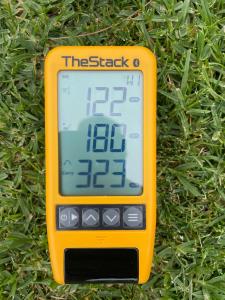
If you are swinging as fast as you would expect, or faster, based on the speeds you see in training, you know that you do not have an issue bringing your speed to the course. In this case, assuming you want to continue getting faster, you just need to keep training.
On the other hand, if you realise you are holding back a lot on the course, and you know from training you are capable of far more, without getting out of control, you have a transfer issue. You need to get more comfortable freeing up on the course and letting yourself express the speed you have. Simply having the radar for feedback, and using it while you practice on the course can be very helpful in this regard. You will probably get more out of more on course context specific practice, than simply training speed off the course or developing physically in the gym.
Remember it’s OK to hit bad shots in practice as part of your development. Oftentimes trying to be careful and holding back doesn’t actually help accuracy or contact compared to swinging a bit more freely and aggressively, which usually has the bonus of extra yards too.
I am not suggesting you put the radar down during important rounds where your main goal is performance. This may be an unwanted distraction.
8. We are training club head speed to increase ball speed, distance, and scores
Club head speed is the limiting factor in distance. Many amateur players get just as much distance out of their swing speed as pro’s do. They are just as efficient at transferring club head speed to ball speed. Far fewer of them swing as fast though! It should almost certainly be some element of your overall improvement plan.
It is worth remembering however that the goal of club head speed is to increase ball speed, which plays a huge role in driving distance.
While you are increasing club head speed, always ensure you keep working on centeredness of strike, launch conditions, and ensuring you have the right equipment for your swing. Otherwise you will not be able to make the most out of your speed. An instructor can help you with this. Adam Young, the golf instructor has some great tips on training strike, too.
I hope you enjoyed the article and get some benefit from the tips.
Regards,
Mike