
Why Mobility Matters for Club-Head Speed
Mobility plays an important role in “golf fitness”. It is essential for enabling sufficient swing length and desirable swing sequencing. If you’re interested in maximising your ball striking, club head speed, and golf longevity, targeted mobility training should be part of your overall golf training plan.
For a full breakdown on everything you need to know about swing speed training for golf make sure to check out Swing Speed Training For Golf – The Fit For Golf Guide
A more mobile body doesn’t automatically produce more speed, but it does set us up nicely. When a golfer has sufficient range of motion in some key areas, such as the hips, thoracic spine, and shoulders, it enables a nice long hand path. Think of your hands traveling around a clock face.
A longer hand path gives you more time and distance to apply force to the club, increasing the total impulse delivered to it. This governs the potential momentum and speed of the club head at impact. Think of it like having a longer runway to accelerate down.
Research by Dr. Sasho MacKenzie and Dr. Phil Cheetham in the Golf Science Journal demonstrated this clearly (How Amateur Golfers Deliver Energy to the Driver). They analyzed how golfers deliver energy to the driver and found that the distance the hands travel, combined with the force applied along that path, explains most of the variation in club head speed between players. In short, the more efficiently a golfer can apply force over distance, along their hand path, the greater the potential for speed.
That finding gives a practical rationale for mobility work: improving rotation in the hips, thoracic spine, and shoulders increases the potential for a longer, better sequenced hand path. It also highlights the importance of muscle strength. It’s hand path distance, multiplied by average force applied along that hand path. The stronger our muscles, and the better our kinematic sequencing, the better chance we have of a higher average force.
As always, maximising club head speed comes down to physical capabilities and swing mechanics.
The following sections walk through how mobility in some key body segments & swing mechanics influence hand path length and club head speed potential.
Amateurs Vs Pros
For a visual representation of this hand path length concept at play here are 4 golfers, paused at the top of their backswing. The first golfer is an amateur that was unhappy with their club head speed and driving distance. After that we have Jack Nicklaus, Sam Snead, and Bubba Watson. These 3 are widely regarded as among the best drivers of the golf ball in their respective eras. They were all extremely long and accurate.
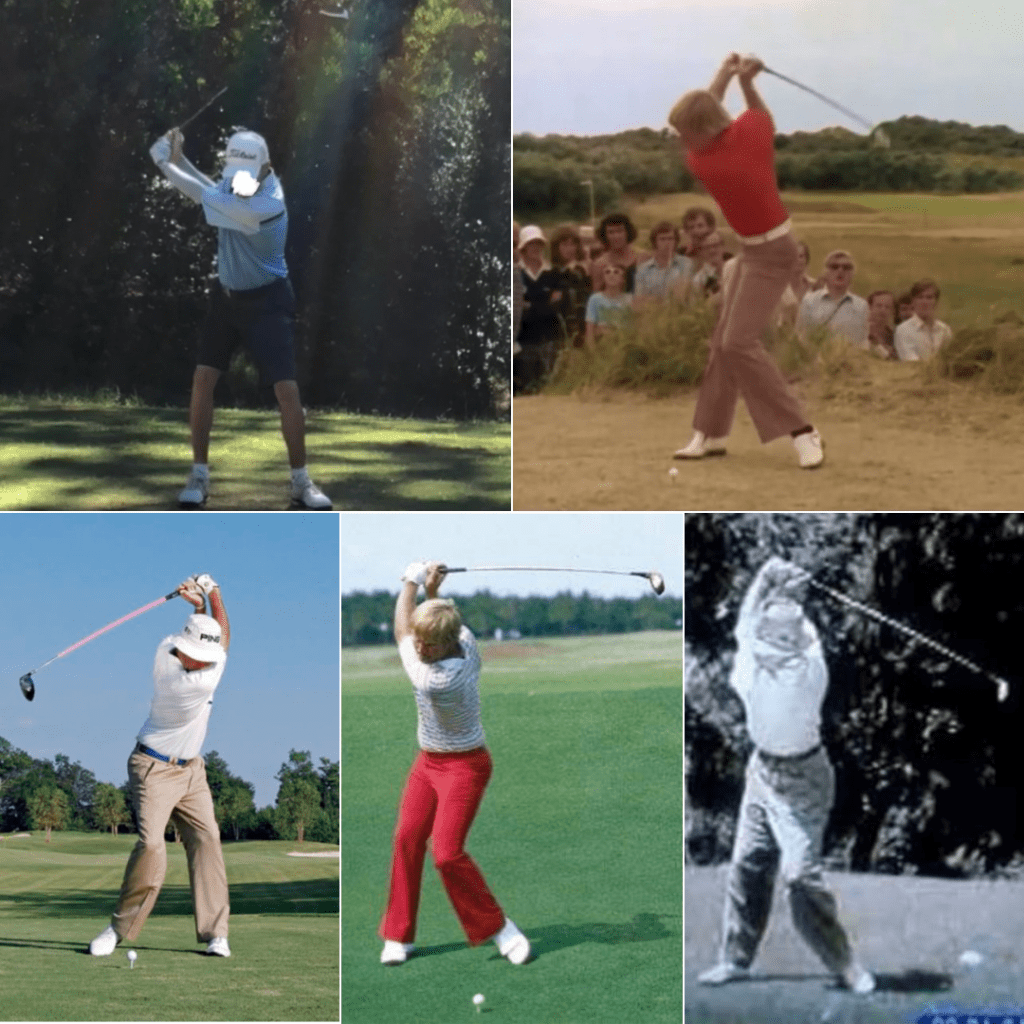
Imagine a clock face around each golfer. 6 at the bottom and 12 at the top. Now study the angle of the lead arm of each player, and how far their hands get “around the clock”.
You will notice that the amateur golfer has significantly less hand path length than the pro’s. This short hand path reduces the amount of time and distance he has to apply force. If your hand path is short, and you want to deliver high club head speed, you better be extremely explosive. Jon Rahm is a good example. Unfortunately, most middle aged or senior amateur golfers do not have good explosive capabilities. (We will be working on it in the Fit For Golf App though 🙂).
In addition to this, you will see very different body positions and degrees of rotation.
The amateur golfer’s lead foot has remained flat on the floor, the pelvis has not rotated much, the torso has not rotated much, which makes it extremely difficult to get the hand path a desirable length. It’s not just the lack of hand path distance that is an issue here.
Due to the lack of rotation, the amateur golfer has very little stretch in the muscles of the hips, trunk, torso, and shoulders. This is problematic, as muscles can contract more forcefully if they are stretched a certain amount first. Think of loading up a catapult.
While I am sure the professional golfers pictured here are more mobile than the amateur, they also make things much easier. You will see they all allow the lead heel to raise off the ground. This in turn makes it easier for the pelvis to rotate, which makes it easier for the torso to rotate, which makes it much easier to get the hands “around the clock”.
The hip, torso, and shoulder muscles are beautifully stretched, and they are wound up to deliver much more speed than the amateur.
In general, amateurs will need to work on their mobility and understanding of swing concepts to start working towards these positions. Note how I said “work towards”. I am not expecting you to get into the same position at the top as Nicklaus, Snead, or Bubba, I am simply using them as a model to work towards. The resemblances between them, and other greats, leave clues!
Golf Mobility – Key Movements
1) Hip Internal Rotation
During the backswing, the trail hip internally rotates as the pelvis turns away from the target, and “into the trail thigh”. You can get a feel for this by setting up in golf posture with your left foot pulled back so you are in a split stance, and rotating your torso over your right leg as far as possible. You will probably feel a lot of tension and loading of the right hip joint and muscles. That is internal hip rotation.
Limited range here forces the pelvis to stop rotating sooner, and as outlined above, this has knock-on effects for the torso and shoulders, shortening the overall hand path.
The golfer may compensate by over-rotating the lumbar spine or lifting out of posture, which disrupts sequencing.
Better hip mobility allows the pelvis to turn more effectively, storing elastic energy through the glutes and trunk and making it easier for the rest of the body segments involved in the wind up.
Test – Lower Quarter Rotation
This test allows you to measure your lower body rotation against a benchmark. Don’t worry too much about whether or not you can get as far as the shaft on the ground now. Just work on gradual improvement. We are all built differently!
2) Thoracic Rotation
The thoracic spine is the mid part of the back and connects to the rib cage. It is the main driver of rotation above the waist. If a golfer struggles with thoracic spine rotation, they will really struggle to load up behind the ball effectively. This commonly results in a short swing, or the golfer might use side bend, and lumbar extension to achieve more length. This isn’t ideal for performance, and could be a reason why your lower back doesn’t feel great after practice or play.
Improving thoracic rotation allows the torso to turn deeper. Coupled with allowing the lead heel to raise the pelvis to rotate, we really start to get into a movement pattern where lengthening the hand path and increasing club head speed is very likely!
A big thoracic rotation also stretches the oblique muscles, priming them for an explosive contraction in the downswing.
Test – Seated Thoracic Rotation
This thoracic spine rotation test is usually a really easy one for golfers to see the importance of. All keen golfers are aware of “shoulder turn”. Shoulder turn is really “thoracic rotation” and like the Lower Quarter Rotation test, this gives you a benchmark to assess your current level and monitor progress.
3) Shoulder Flexion
A simple way to think of shoulder flexion is “arm lift”. The lead arm’s elevation determines how high and wide the hands can travel. Greater shoulder flexion allows a wider arc and more travel of the hands “around the clock”.
Limited shoulder flexion shortens the hand path, and we’ve learned this isn’t good as it reduces your “runway” in the swing. Improved range lets the golfer maintain arm structure and apply force through a larger distance. Remember the impulse principle described earlier?
Shoulder flexion also stretches the lat, a huge muscle group that runs from under your arm pit all the way down your spine and connects to the back of your pelvis. The lat on the lead side of the body (left lat for a right handed golfer), is a HUGE power generator in the swing. We want to be able to really stretch this massive muscle group to take advantage of its huge force potential.
Test – Wall Shoulder Flexion
Shoulder flexion or “arm lift” is really important in the lead arm. This test makes it simple to check yours.
Mobility For The Golf Swing – Give Yourself a Fighting Chance
Mobility improvements in these areas can hugely influence the function of your golf swing. We need to be able to access certain ranges of motion in these key body segments to make powerful golf swings. Without these movement capabilities, it is more likely we will go searching for range of motion elsewhere. Compensations like this aren’t automatically bad, but there’s a reason why almost all high level players move their bodies in reasonably similar ways. Of course there are variations, but there are more similarities in the gross body moves than differences. They show up in other rotational actions too, not just the golf swing. Physiology and biomechanics can’t be defeated.
The good news is that mobility is extremely easy to train and can have rapid improvements. You can do a lot with zero equipment too.
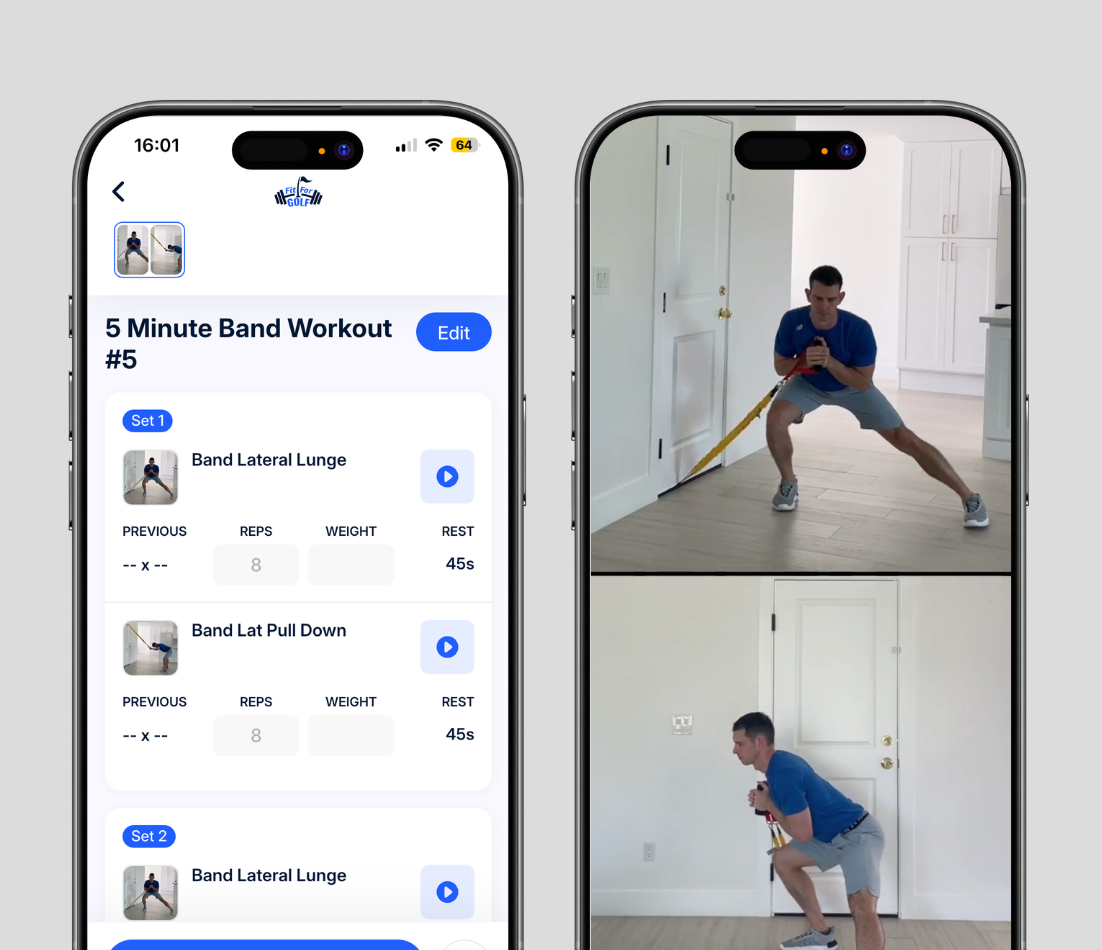
Every workout on the Fit For Golf App starts with a dynamic mobility / warm-up routine, and mobility is also targeted in many of the power and strength exercises. A little known fact is that strength training through the full range of motion at a joint is extremely good for mobility. You can get stronger and more mobile at the same time. A win-win and huge time saver.
Proof Of Concept
As well as writing articles and designing programs, I like to actually work on the things I prescribe. While you don’t have to be able to demonstrate a high ability level to guide others effectively, I certainly think spending a lot of time working on concepts yourself is important.
Here’s me hitting 125.5mph club head speed, 186.7mph ball speed, and 323 yards of carry, during a recent training session, at 5’10 and 170lbs. I’ve used the concepts I prescribe to hugely increase my own club head speed in the last few years. It’s not just theory 🙂
Mobility Testing and Routines in the Fit For Golf App
If you’d like to identify where your own mobility might be limiting your swing, the Fit For Golf App includes a complete TPI Self-Assessment Guide. It walks you through simple tests for hips, thoracic spine, and shoulders with clear video demonstrations and performance benchmarks. Each test has an accompanying exercise that can be practiced to improve range of motion in that area.
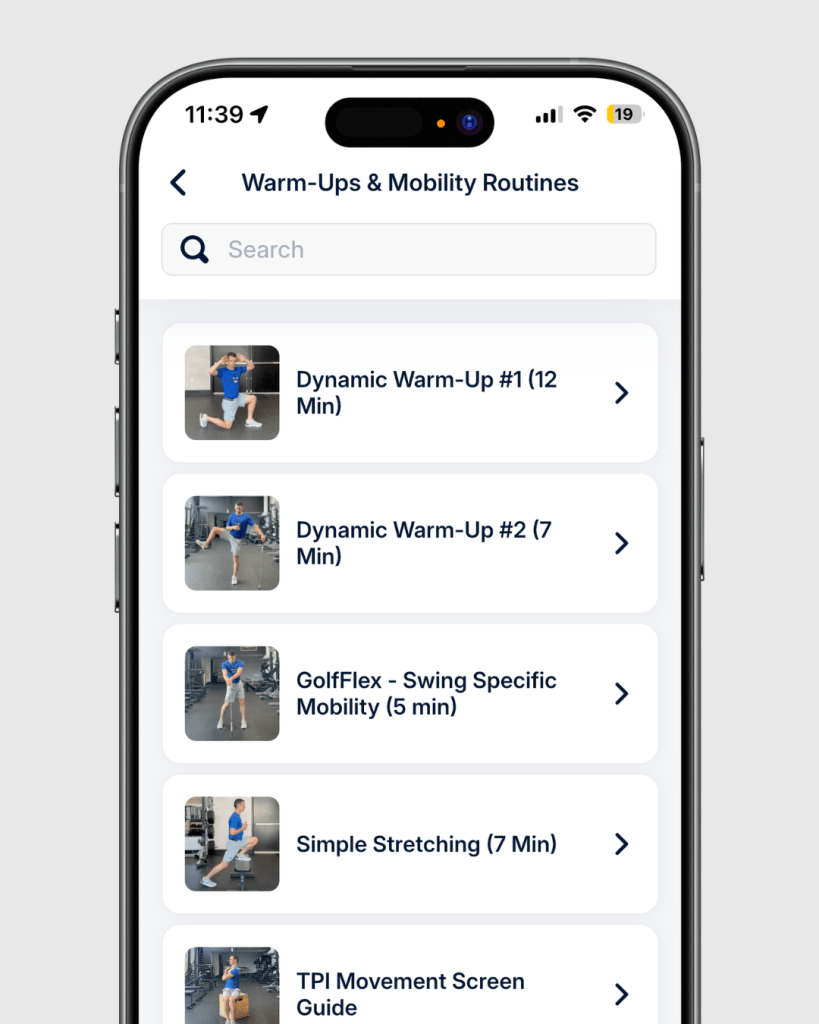
The App has a comprehensive Golf Warm-Ups & Mobility section. These sessions take about 5–10 minutes, require minimal equipment, and can be done before a round or as extra mobility work on days in between workouts. If you do them regularly, you can be sure you are hitting all your mobility needs.
All of the PGA Tour pros I work with do Dynamic Warm-Up #1 before every single workout and round. A lot of app users do this a “daily minimum”. If life gets hectic, they know they can do this in 10 minutes and stay on top of their basic mobility needs and get some healthy movement in.
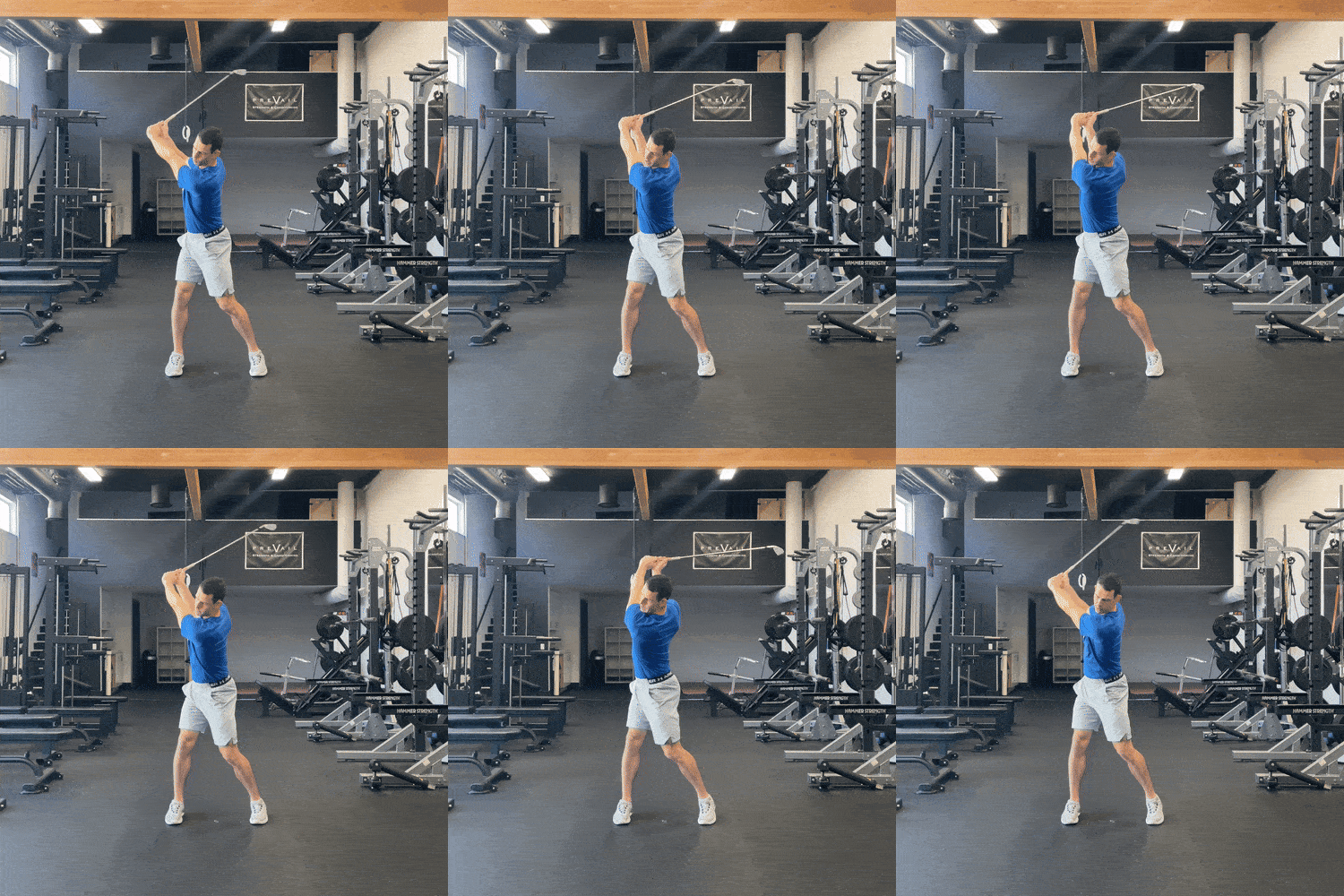
The GolfFlex routine more directly hones in on exactly what needs to be done to improve handpath length, a key element of maximizing your club head speed.
Mobility & Strength – The Essential Combo For Golf Fitness
Workouts for golf require a comprehensive combination of mobility for hand path distance, strength to enable higher force production, and rate of force development to tap into our strength more quickly.
Trying to cover this in your workouts can get overwhelming. With the Fit For Golf App you can rest assured this is taken care of, in every workout.
The next steps are simple!
- Start your 7 Day FREE Trial on the Fit For Golf App
- Follow the App’s prompts through the Program Matcher to find the most appropriate program for you
- Enjoy the routines in the Golf Warm-Ups & Mobility Routines on the days in between workouts
- Enjoy your improvements
You don’t want to continue? No problem. Cancel during your trial and you don’t pay a cent.
Start your 7-day free trial