
Off season training for golf – Why this is the best time to transform your physical capabilities for golf and life.
During the season, most golfers are trying their best to maximise on course time as much as possible. It can be difficult to stay on top of workouts when golf practice and play time is at its peak. The off season, on the other hand, is a significant block of time when you can truly focus on improving your body for golf.
If you use it well, it can be absolutely transformational.
Many golfers include swing speed training as part of their off-season transformation. If that is of interest to you, make sure to check out Swing Speed Training – The Fit For Golf Guide.
Off Season Training For Golf
Golf is a sport heavily reliant on physical power. At every level you go up, physical capabilities are higher and club head speeds are faster. If you are over 40 and have lofty golf goals, it’s highly likely physical training needs to be a top priority. The good news is that the physical capabilities we need to work on for maximizing golf performance are also essential for maximising health span and longevity.
What should we focus on in our workouts for golf (& life!)
Mobility
Adequate range of motion in key areas ensures we can achieve the rotation and swing length we need in the swing. How much we turn our pelvis and torso, and how far our hands travel “around the clock” in the backswing, play a very important role in our club head speed. Without sufficient mobility in these joints we are fighting a losing battle. The beauty of mobility training is that it doesn’t require any equipment and is not very taxing. Everybody can do it, and the gains are immediate. It doesn’t even require much training time.
Strength
This is essential for developing or at least maintaining muscle mass, and enabling our muscles to produce the force necessary for the club head speed we desire. Strength is also what allows us to carry out daily tasks that were once easy, but get tougher as time ticks on. In my opinion, muscle strength is the most underappreciated physical quality in the general population. Maintaining it is critical, and requires specific training. Everyday tasks or just being active is not sufficient.
Rate of Force Development
Strength is the most amount of force we can produce. Rate of force development is how quickly we can do so. This is important in the golf swing because there is not enough time to ramp up to maximum force. We need to be able to apply our strength in a rapid fashion. Strength levels play a key role, but implementing some explosive training exercises is also very valuable.
Rate of Force Development declines more quickly and severely than muscle mass or muscle strength as we age. This is part biology and part cultural norms. A miniscule % of adults train explosively. The Fit For Golf App will help you scale this essential element of training to your current fitness level.
While we absolutely need to stay on top of these qualities year round, trying to increase them during the golf season is difficult. Time is limited due to practice and play, and so are your recovery resources. It’s simply hard to fit everything in, and nobody wants to be fatigued or have muscle soreness when they’re trying to reduce their handicap.
Workouts for golf need to support our playing goals, not hamper them. (Don’t worry, Fit For Golf has in season training covered too. Effectively organising in season training is a key element of the consultation work I do with PGA Tour Pros).
Here is Mackenzie Hughes talking about the impact Fit For Golf had on his club head speed during his press conference after winning the 2022 Sanderson Farms Championship.
Golf Workouts Are Longevity Workouts
This isn’t news, but as we age, we lose muscle mass, muscle strength, and muscle power. This leads to a cascade of effects that are catastrophic for golf and life.
Strength and power are very important for golf performance and general life function, and muscle is an essential organ for metabolic health. There is no uncoupling of the relationship between “golf fitness” and “life fitness”.
It’s not all bad news. All of these things are extremely modifiable at all ages of life. With appropriate training we can hugely alter our muscle mass, strength levels, and explosiveness.
There is very encouraging research showing that resistance training quite literally turns back the clock on muscle health. The same training plan that will help increase your club head speed and distance with all clubs are also what help you stay physically capable, resilient, and independent as you age. Training for golf and training for life are not separate things. Done properly, they are one and the same.
Science Informed Protocols
The type of training I prescribe is not just what I think is a good idea. It is backed by science. My experience in training thousands of people of various ages and fitness levels enables me to scale the training appropriately while still ensuring all the critical elements are being worked on. Start at an appropriate level, slowly and gradually increase the demand of the training as you improve. This is exactly how the programs on the Fit For Golf App have been created.
Two landmark studies illustrate just how well older adults are still able to increase strength and RFD.
Guizelini et al. (2018) conducted a systematic review and meta-analysis of ten intervention trials involving men and women aged 60 to 83 years.
Across 8–16 weeks of supervised resistance training (two to three sessions per week using moderate-to-heavy loads), participants improved:
- Maximal strength by ~18 %, and
- Rate of force development by ~27 %.
In practical terms, that means older adults got stronger and improved the ability to produce force faster, an ability that typically declines with age and is crucial for both your golf swing and everyday function.
In another study, Aagaard et al. (2002) trained adults aged 67–72 years for 14 weeks using progressive lower-body strength exercises three times per week.
They observed:
- ~48 % increase in RFD
- ~22 % increase in neural drive (motor-unit recruitment and firing rate).
The authors concluded that the neuromuscular system of older adults remains highly adaptable, resistance training effectively “re-awakens” the ability to generate force quickly, reversing decades of decline.
Together, these studies show that even in the seventh and eighth decades of life, consistent resistance training can substantially improve both strength and explosive power — two of the best predictors of athletic performance and functional independence.
A Simple Off Season Golf Workout Framework
You don’t need a complicated plan. The best results come from doing simple things consistently and progressively. To summarise the 3 key areas to focus on:
- Mobility: Particularly in the hips, back, and shoulders. In the Fit For Golf App this is targeted in the dynamic warm-up & mobility routine before all workouts. Zero equipment required to work on these.
- Strength: A focus on big muscle groups and movements crucial for total body strength. Squats, hinges, presses, pulls, and rotational core work.
- Rate of Force Development: This is the explosive element of your training that almost all training programs miss. Things like jumps, med ball throws and slams, explosive band work, and other high speed light weight exercises. The beauty of the Fit For Golf App is that not everyone will do these exercises right from the start. Depending on your starting level, they might not appear until you are a number of weeks into your training, with a solid base already built.
The Program Matcher in the app ensures you select an appropriate program for you. Not everyone has the same background and experience, so we scale workouts to you!
In general, I prescribe 3 workouts per week, of 20 to 60 mins depending on the program. There are lots of options to suit your preferences and schedule.
If you follow the plan, you will see stark differences when the spring comes and it’s time to get back on the course. Many golfers have been completely transformed!

Sample Golf Fitness Workout Exercises
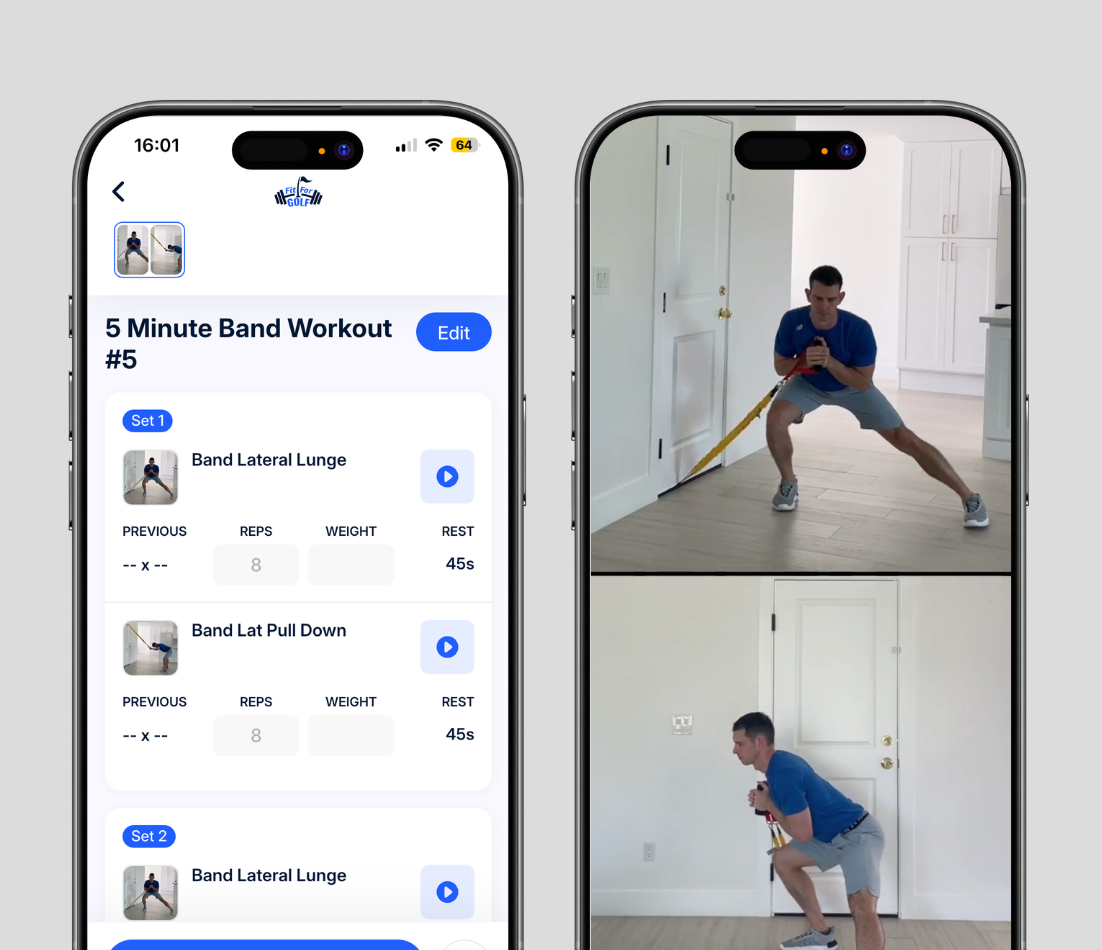
These are the sample movements I build into off-season programming. A full program is much more comprehensive. Equipment recommendations adjust based on whether you select home or gym workouts in the app.
1. Dynamic Warm-Up / Mobility
90/90 Hip Rotation
Improve hip rotation
Half-Kneeling Thoracic Rotations
Improve upper body turn.
2. Power & Speed (2–3 sets of 5-6 reps)
High Speed Band Rotation
Trains many of the fast twitch fibers of the trunk and core.
Countermovement Jumps
Trains the fast twitch fibers of the lower body. The legs are a huge contributor to swing speed and stability.
3. Strength (2–3 sets of 5–8 reps)
Split Squat
Builds leg strength and muscle mass. Essential for fighting Father Time!
Single-Arm Dumbbell Row
Builds upper body strength, especially in the lats, upper back, and rear shoulders. The lats are another huge power source in the swing.
Swing Speed Training – A Key Addition
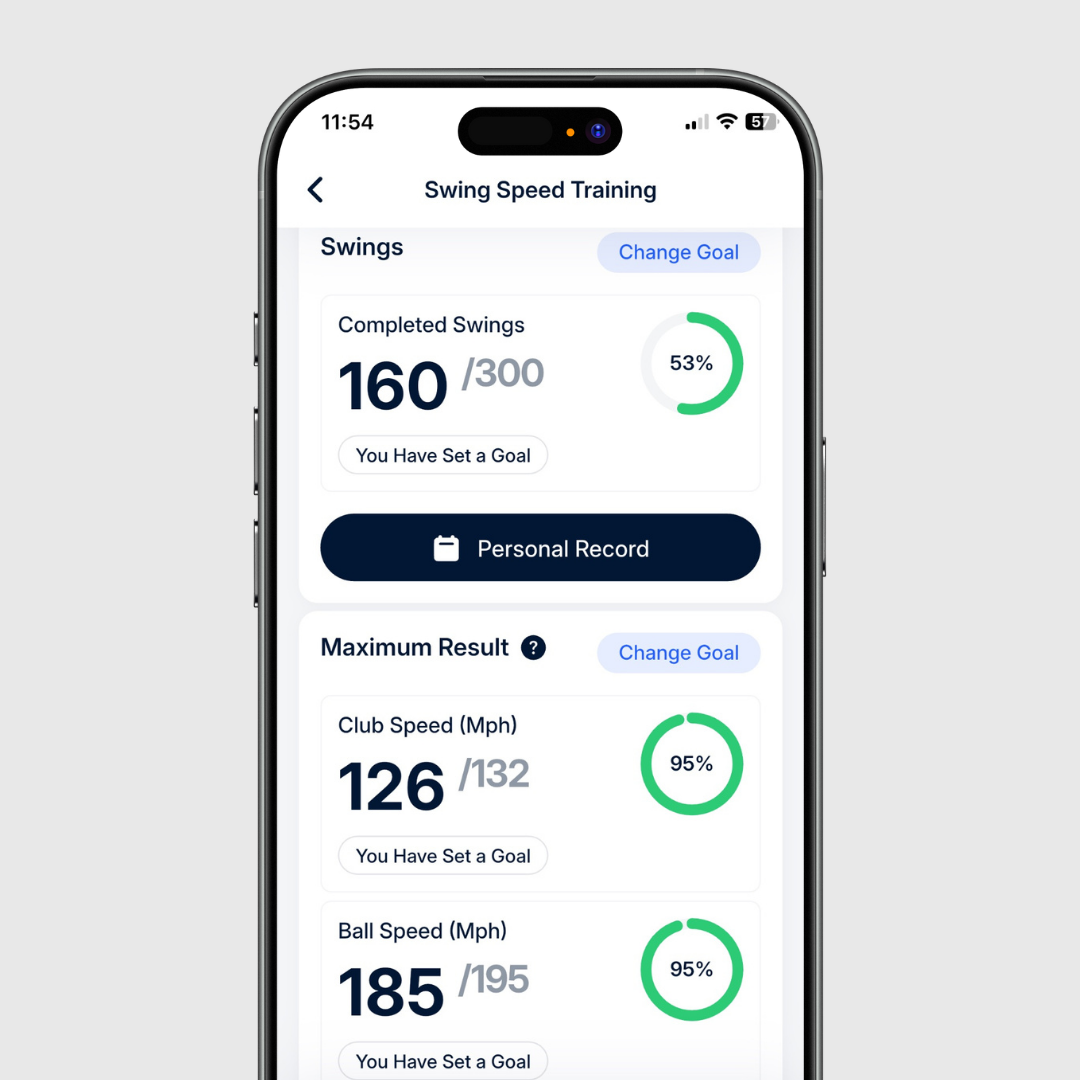
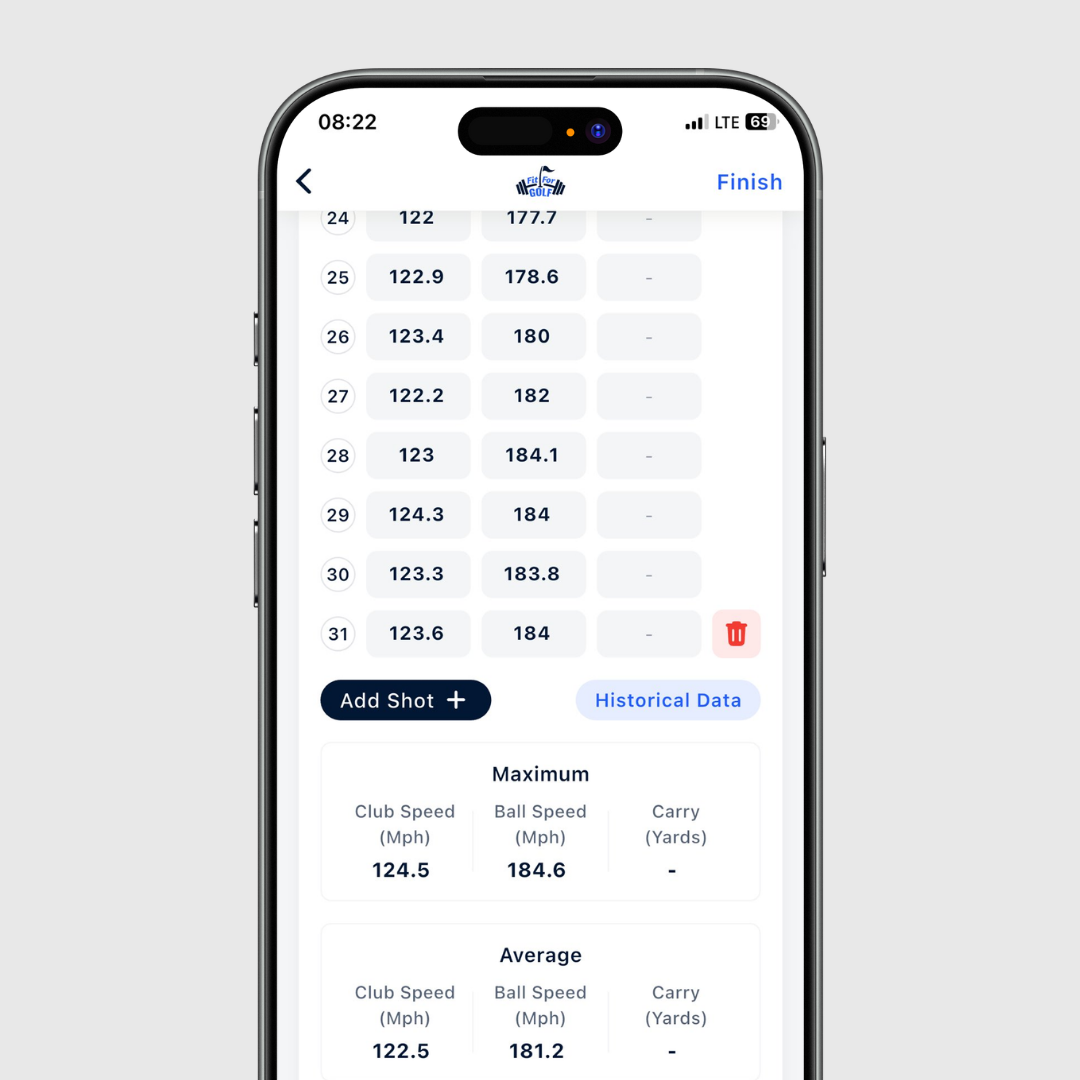
In addition to the workout structure outlined above, the Fit For Golf has another feature setting it apart. There is a Swing Speed Training feature that allows you to track your club head speed, ball speed, and carry distance as you train. (Or just club head speed if it’s easier for you to make air swings from home).
Adding direct swing speed training really amplifies the effects of your workouts when it comes to increasing club head speed and distance.
The workouts develop your physical capabilities, and swing speed training allows you to work on coordinating it directly into the skill you are trying to improve. It is imperative we include actual swinging as part of your all round “golf fitness and speed program”.
All you need is a radar and your driver. After being guided through the warm-up on the app in the Swing Speed Training section, simply make 10 warm-up driver swings, then 10-15 driver swings where you try to reach as high a club head speed as you can.
Enter your results in the app, and repeat 2-3 x week to really maximise your training.
Long Term Payoff
The off season isn’t just about adding distance for next year. It’s about investing in your body so you can keep playing, practicing, and living actively for decades.
Physical training is the best “anti-aging” tool we have. My passion and expertise is helping people maximize theirs.
Getting Started
It’s simple! If you want to transform your body for golf and life using Fit For Golf, do the following.
Go through the checkout to create your account and start your 7 day FREE Trial.
Download Fit For Golf 2.0 from the app store and choose Log In.
Make sure to log in by entering the email address you signed up with.
Then once you are in the app, simply follow the apps instructions!
If you don’t want to continue with a paid subscription, simply cancel and you will not be charged!
For the best possible value, choose annual when signing up and use the code OFFSEASON26
Start your 7-day free trial
Success Stories
Since John started using the Fit For Golf App, he’s seen remarkable results
- Club head speed up: 105 ➝ 122 mph
- Handicap down: 3.5 ➝ +0.8
- Left shoulder injury: gone
- Flexibility & explosiveness: way up
Dana, 35, 16 hcp. Busy Mom of 2.
- Gained distance off the tee
- Back pain gone
- Trains at home with minimal equipment
- Huge increase in total body strength
- Fits workouts into a busy schedule
Pat has been using the FFG app for 3 years!
- Over 650 workouts logged
- Club head speed improved
- Distance improved
- Fitness improved
- The best golf fitness app, very highly recommended