
Muscle is important for far more than appearance. It is essential for everyday movement, long-term health, and how well your body regulates blood sugar and body fat. It also plays a major role in club-head speed and long-term golf performance. Losing muscle mass and strength is one of the biggest hurdles golfers face as they get older.
If you are over 35, gaining and maintaining muscle needs to be a priority. The off-season is the perfect time to start working on it.
Why Muscle Mass Matters
1) Function and Longevity
Muscle allows you to move efficiently, stabilize joints, and maintain posture and balance. It is also essential for generating power in athletic movements like the golf swing.
Once you start losing it, everyday tasks get harder — walking uphill, carrying groceries, getting up from the ground, and generating club-head speed. Research shows adults can lose 3–8% of their muscle per decade after age 30, and the rate often doubles after 60 (Volpi et al., 2010). This process, sarcopenia, is a major predictor of loss of independence later in life and it will hurt your golf game. Less club-head speed, less distance, and fewer greens in regulation.
The good news: it is not inevitable, and you are in control. Studies show that resistance training, even when started late in life, can restore significant strength and lean tissue (Stec et al., 2017).
If you haven’t already, check out Off-Season Golf Workouts for how to organize your off-season training.
2) Metabolic Health
Metabolic health describes how effectively your body produces, stores, and uses energy. When it’s good, blood glucose, blood pressure, and blood lipids stay within healthy ranges without medication. When it declines, several issues often appear together — a condition known as metabolic syndrome.
Metabolic syndrome is diagnosed when a person has three or more of the following:
- Elevated blood glucose or insulin resistance
- High blood pressure
- High triglycerides
- Low HDL (“good”) cholesterol
- Excess abdominal fat
These factors reflect how well the body regulates and uses energy. When several are out of range, the risk of developing type 2 diabetes and cardiovascular disease rises sharply. About one in three adults in the U.S. meets the criteria, and more than half of adults over 60 are affected (Moore et al., 2017, J Am Heart Assoc).
The unifying issue behind these risk factors is that the body becomes less efficient at handling and storing fuel. After you eat, carbohydrates are digested into glucose, which enters the bloodstream. This is a normal and necessary process — glucose is one of the body’s most important energy sources. Insulin then helps move that glucose into tissues where it can be used or stored.
Skeletal muscle is the main site for this process. Around 75–85% of post-meal glucose uptake happens in muscle tissue (DeFronzo & Tripathy, 2009, Diabetes Care). Inside muscle cells, glucose is stored as glycogen, where it becomes an available fuel for both daily activity and exercise.
When you have more muscle, you have a larger “sink” for glucose, a greater number of insulin-sensitive cells, and more mitochondria to convert that stored fuel into energy. This keeps blood glucose and insulin levels in a healthy range and supports steady, reliable energy throughout the day.
When muscle mass declines, this system becomes less effective. Glucose clearance slows, the body releases more insulin to manage it, and over time this leads to insulin resistance, the main driver of poor metabolic health.
Research consistently shows that people with higher muscle mass are far less likely to develop insulin resistance, metabolic syndrome, or type 2 diabetes (Srikanthan & Karlamangla, 2011, J Clin Endocrinol Metab). Regular resistance training directly improves these markers, even in older adults, by increasing muscle size, strength, and glucose-handling capacity (Holten et al., 2004, Diabetes).
Muscle is not just important for strength or sport. It’s a metabolic organ that helps the body manage energy efficiently. Building or maintaining it through resistance training and proper nutrition improves how your body uses carbohydrates, keeps blood sugar stable, and protects long-term health.
This might not seem directly related to golf performance now, but if you plan on being healthy enough to enjoy golf for a long time, it is critical.
3) Golf Performance
From a performance standpoint, muscle contributes to club-head speed through its role in force production. Strength and power are two sides of the same coin: the stronger the muscle, the more force it can produce in a given time frame.
Multiple studies have linked lean mass and strength with faster swing speeds and longer carry distances. Keogh et al. (2009) showed that club-head speed in elite golfers correlates strongly with lower-body power and trunk rotation strength. A 2021 meta-analysis found that golfers who completed resistance-training programs increased club-head speed by 4–6% on average in just eight weeks (Lee et al., 2021).
Building muscle isn’t about bodybuilding. It’s about giving your body the physical resources to produce and control force more efficiently through the swing.
For practical examples, see 5 Best Strength Exercises for Golfers and Golf Mobility Exercises for Club-Head Speed.
How Muscle Slips Away
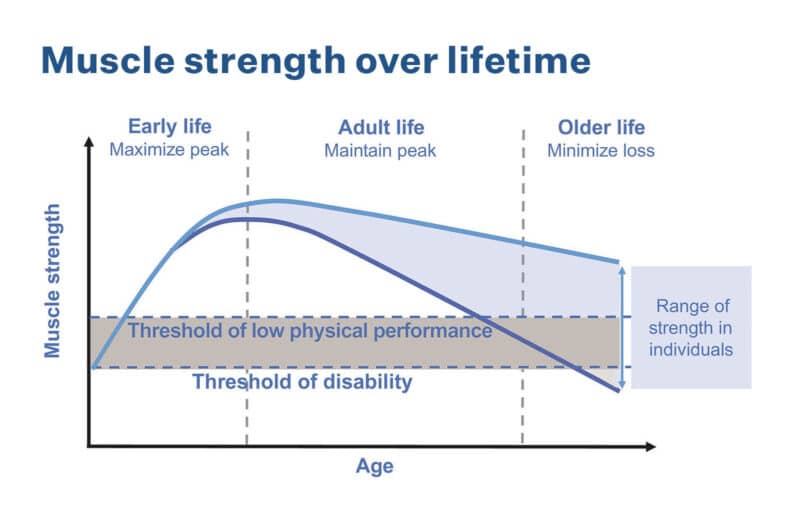
Image from – www.effectexercisephysiology.com.au
Muscle loss is mostly a result of underuse. When training volume or intensity drops, the body no longer receives enough mechanical stimulus to maintain muscle protein synthesis. Combine that with lower protein intake, reduced hormones, and increased inactivity, and muscle gradually erodes.
If you lose 5 lb of lean mass, you also lose roughly 200 kcal of daily metabolic rate. You burn fewer calories at rest, making it easier to gain fat even when eating the same amount.
This process is often silent for years. Many only notice it when they feel weaker, stiffer, or more easily fatigued. It is happening in most adults. Even if body weight is stable, muscle mass may be declining while body fat increases. Don’t let this happen.
Why It’s Never Too Late
A common myth is that building muscle past 50 or 60 is unsafe or ineffective. In reality, older adults respond very well to structured resistance training. Muscle and strength gains are meaningful, and injury risk is low.
A review of 49 studies found that adults over 60 can gain 2–5 lb of lean mass and 25–30% strength in 12–20 weeks of training (Peterson et al., 2010). Another study showed that participants in their 70s who trained twice per week improved insulin sensitivity and muscle size with no serious injuries reported (Stec et al., 2017).
The key is progressive overload: start light, learn proper technique, and increase resistance gradually. The body adapts at any age when the stimulus is right.
If you are younger or in your physical prime, build as much muscle as possible. It gives you a reserve and a buffer for when biological aging makes maintaining and gaining muscle harder.
How to Train for Muscle
The foundation of hypertrophy (muscle growth) is mechanical tension, sufficient volume, and recovery.
- Frequency: Train each muscle group 2–3 times per week.
- Reps & Load: A wide range can build muscle if sets are challenging. Anywhere from 3–30 reps works, but 5–8 reps per set is often most efficient.
(The Mass program in the Fit For Golf App uses a high number of sets on primary lifts to reach target weekly volume.) - Sets: Around 10 per muscle group per week, ideally spread across 2–3 sessions.
- Progression: Add small amounts of load or reps each week.
- Exercises: Focus on big compound lifts but include isolation work as needed.
Squats, hinges, upper pushes, and pulls should form most of your training. See 5 Best Strength Exercises for Golfers.
Training at home can be highly effective. Dumbbell, band, and bodyweight exercises work if performed close to muscular fatigue. The key is effort.
The Mass and Mass Home-Based (Dumbbell) programs in the Fit For Golf App are built to maximize muscle while addressing the specific needs of golfers. The off-season is the ideal time to work hard and push for measurable gains.
Nutrition and Recovery

Training provides the stimulus. Nutrition and recovery provide the building blocks.
Protein:
Aim for about 0.7–1.0 g per lb of lean mass per day. If you’re 200 lb and estimate 25% body fat, base intake on 150 lb. Spread protein across 3–4 meals with 25–30 g each.
Good sources include lean meat, fish, fat-free dairy (especially Greek yogurt), egg whites, and high-quality plant blends (soy or pea-rice). Get protein early in the day — most people under-eat it at breakfast.
Calories:
Many golfers can achieve “recomposition” — losing fat while gaining muscle — with a slight calorie deficit (about 200–300 kcal), sufficient protein, and hard resistance training.
Recovery:
Sleep 7–9 hours per night. Older adults often need to pay extra attention to protein, sleep, and consistency due to age-related anabolic resistance. For more ways to speed up recovery, check out our golf recovery tips.
Why the Off-Season Is the Perfect Time
During the golf season, practice and play can dominate time and energy. If a workout makes you sore before a round, it’s tempting to stop resistance training altogether. That’s a mistake. For an approach that works in competition months, see In-Season Golf Training.
The off-season is when you can train hardest. With fewer rounds, you can lift heavier, increase sets, and recover fully. This is when you build the engine.
Adding muscle now improves health, power, and next season’s performance.
The Mass programs in the app — both the original and Home-Based Dumbbell versions — are designed for exactly this purpose.
Fit For Golf App Results
“After finishing Mass and Force last winter, my club-head speed went from 101 mph to 108 mph and I’ve never felt stronger on the course.” — Adrian T., 45
“I’m 65 and thought heavy lifting was risky. After 3 months on the Home-Based program, my back pain is gone, my energy is better, and I’m hitting it farther than I have in years.” — Rob W., 65
Thousands of golfers have followed this same progression. Train consistently through the winter and arrive in spring stronger, leaner, and faster. You can view more Fit For Golf success stories here.
Key Takeaways
- Muscle is essential for golf performance and health.
- It’s the main tissue for glucose regulation and metabolic health.
- Muscle loss is preventable and reversible at any age.
- Resistance training is safe when properly programmed.
- The off-season is the best time to prioritize it.
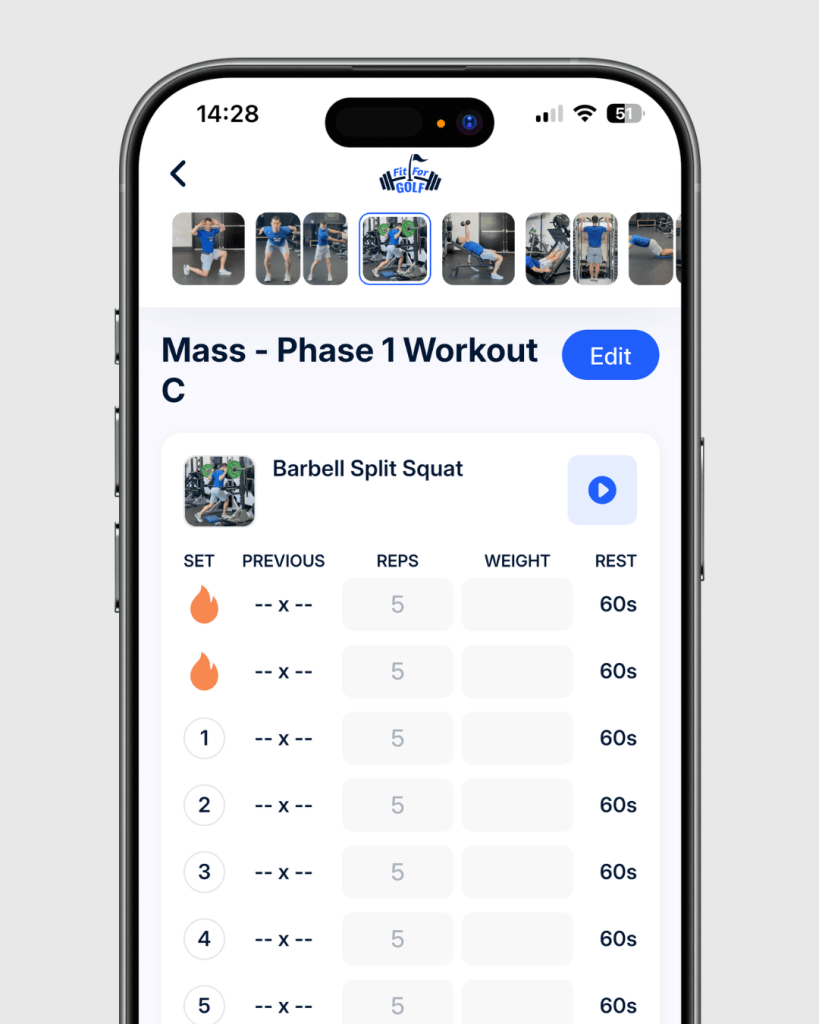
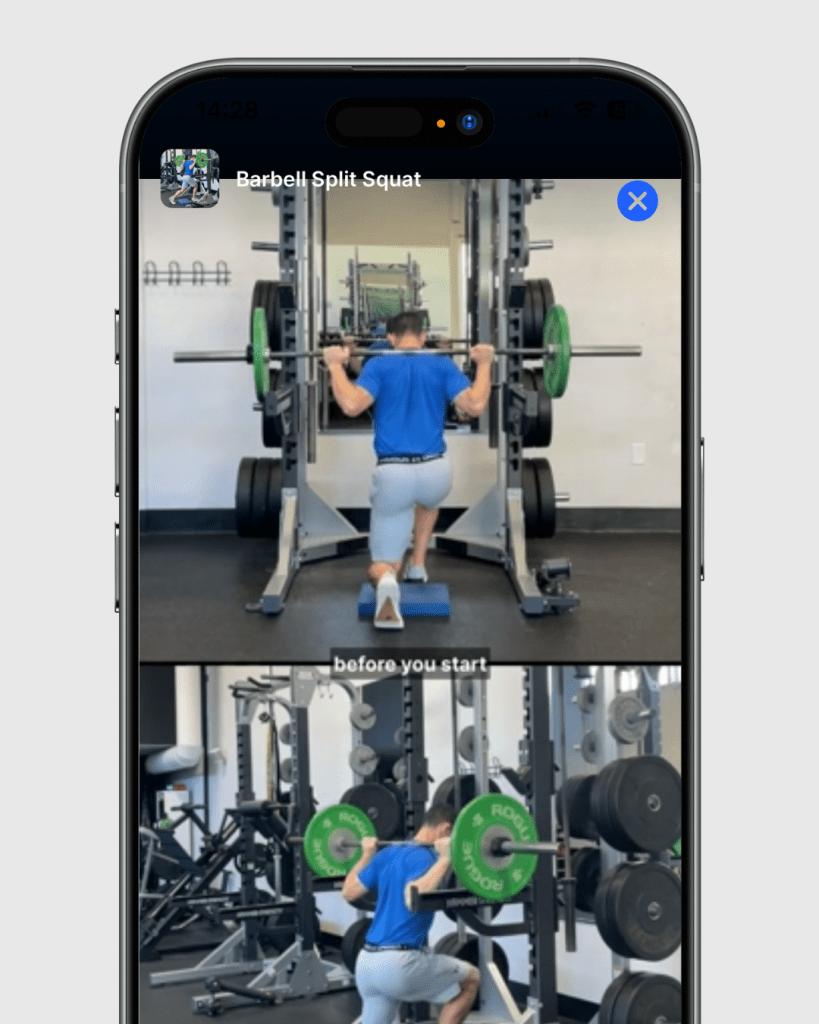
If you want a structured plan to rebuild strength and muscle this winter, try the Fit For Golf App.
The Mass and Mass Home-Based programs include step-by-step workouts, progress tracking, and full video demonstrations.
What happens after Mass? Then it’s time to go through the Force and Velocity programs. The Fit For Golf App includes a full year of periodized training designed for golfers. If you go through these three programs and aren’t completely satisfied, I’ll refund your entire subscription.
Start your 7-day free trial and make this off-season the time you invest in the muscle that powers both your golf and your long-term health.
Off-Season Golf Training Series
Continue the series:
- Off-Season Golf Workouts: Build Mobility, Strength & Club-Head Speed
- Golf Mobility Exercises for Club-Head Speed
- Next: Off-Season Nutrition for Golfers (Coming Soon)