
This short article is derived from Strength Training For Golf – The Fit For Golf Guide. That article goes into detail on everything you need to know about strength training for golf. In this shorter piece, I am providing theoretical knowledge about exactly what happens as a result of strength training.
I program strength training as full-body splits two or three times per week for almost all golfers. It keeps scheduling simple and allows more time for the other things that matter — golf practice and play, speed training, cardiovascular training, and life outside the gym.
Each full-body workout includes some lower-body, core, and upper-body work. The exercises in each workout are adjusted so that across the week, all key movement patterns and muscle groups are trained sufficiently. This is very different from the traditional bodybuilding approach of “arms day,” “back day,” or “legs day.” Those routines were designed for physique goals, not for improving strength, power, and performance in a sport like golf.
Full-body sessions are also less fatiguing for each muscle group. You give every area a small dose of work, recover quickly, and repeat. This approach works much better than hammering one muscle group, as happens with “leg days,” “arm days,” or “chest days,” and then being in recovery mode for several days.
Another very important limitation I have noticed from “body part splits” is that quite often, the lower body is not trained to the same level as the upper body. This is not ideal for athletic performance or general longevity. In a four- to five-day weekly training split, there might be three or four upper-body focused days, with just one “leg day.”
Additionally, the upper-body workouts are always broken down into specific muscle groups, while the very important lower-body muscles all get dumped under the “leg category.” I may be generalising a little here, but this is quite common and is one of the reasons why bodybuilding or generic gym programs miss out on critical programming elements.
Stimulate a little — rest — repeat. Two or three quality sessions per week, done consistently over time, will lead to huge long-term progress, provided you keep striving to increase the stress of the stimulus.
How to Get the Benefits of Strength and Type IIa Hypertrophy Without Blunting Speed
You can build strength and size without interfering with speed and power if you manage fatigue and plan your training goals across the year.
When the goal is to get bigger and stronger, like in the and , total training volume and, as a result, fatigue are higher. This extra work builds the cross-sectional area (CSA) of the Type II fibers and upgrades your overall force potential. The trade-off is that these phases can create some short-term fatigue and slightly blunt club head speed while you are in the middle of them. That is completely normal and is not cause for concern. It is impossible to be at maximum speeds while simultaneously trying to maximise strength or hypertrophy.
Strength training and activity in general tend to shift some of the fastest Type IIx fibers toward the slightly slower, but more fatigue-resistant, Type IIa fibers. This may sound like a negative issue, but it is likely a beneficial trade off. As the cross-sectional area of these fibers increases, they can produce more force while still contracting fast enough to help with club head speed.
Club head speed is an explosive activity, a blend of strength and speed, rather than a pure maximum speed activity. Bigger Type IIa muscle fibers play an enormous part in explosive strength. I dug into this further in the Science of Speed article .
The same principle applies in other rotational power sports, like track and field throwing and baseball. Baseball pitchers, for example, often throw dramatically faster as they gain muscle and strength. This is one of the key findings that Driveline Baseball, a premier baseball training facility, regularly reports. The added lean mass and force potential simply allow them to produce more power in the same motion. Golf is no different.
Here is a video of Valerie Allman, the world’s best female discus thrower, performing strength training to support her goal of throwing the discus farther. This type of training is close to perfect for golfers. Her potential for club head speed would be very high.
Short-Term Fatigue, Long-Term Gains
When training volume is reduced and you move into the or programs, fatigue drops, explosiveness and rate of force development are maximised, and those now bigger and stronger Type IIa fibers can then be expressed as high-speed power houses. This is when club head speed typically peaks, especially if combined with specific swing speed training.
During the , the goal shifts to maintaining those strength and power levels with lower volume and minimal fatigue so you can perform your best on the course.
Track and field athletes are a great example. Sprinters and jumpers lift heavy year-round but manage fatigue through moderate volumes, staying far from failure in explosive work, and prioritising recovery between high-intensity sessions.
Golfers can follow the same logic. Build the base in the off season with higher volume strength work, then emphasise lighter, faster, lower fatigue training as you move into peak season.
The sequence of Mass → Force → Velocity → In-Season follows a sequential progression, with one program setting up the next. This is one of the things that separates Fit For Golf from other “Golf Fitness” resources. I am not providing “golf workouts”. I’m providing structured, year round programming, with key physiological adaptations in mind.
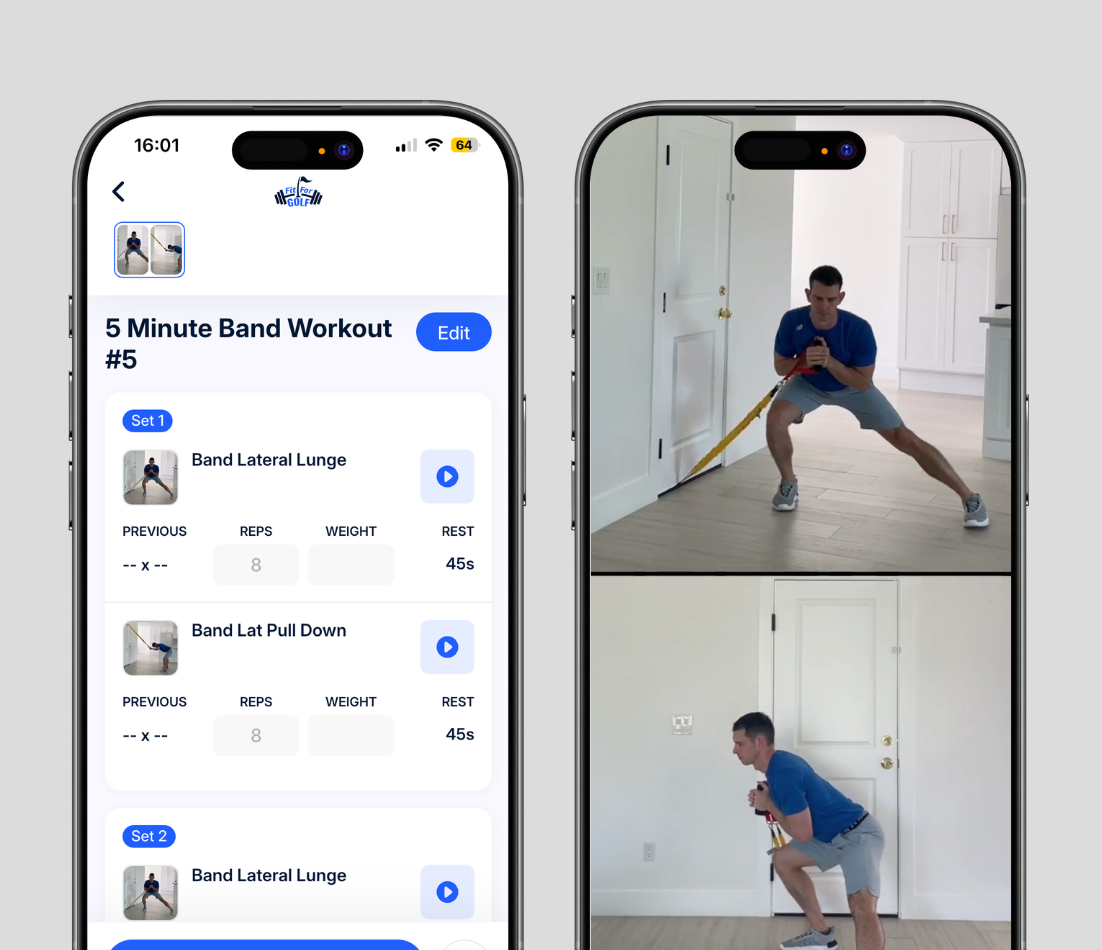
You get access to all of these programs with the 7 Day FREE trial on the Fit For Golf App.
If you want to see how these concepts are applied to designing training programs, and learn more about strength training for golf, check out my most comprehensive article on the subject, Strength Training For Golf – The Fit For Golf Guide.