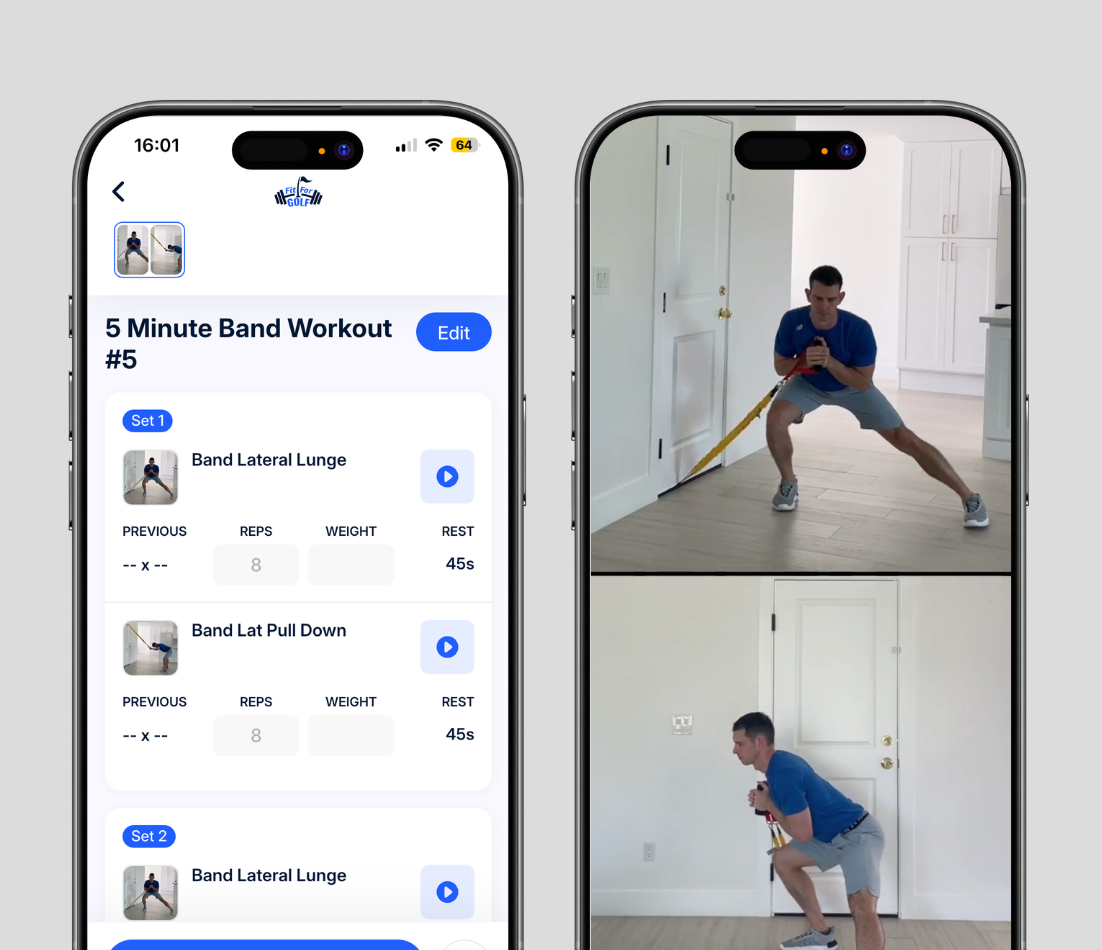

This short article is derived from Strength Training For Golf – The Fit For Golf Guide. That article goes into detail on everything you need to know about strength training for golf. In this shorter piece, I am providing theoretical knowledge about exactly what happens as a result of strength training.
Heavy vs Moderate vs Light Loads
1RM refers to one-rep max — the most weight that can be successfully lifted for one rep in a particular exercise. This amount is commonly used as a baseline to assign training weights.
You do not need to, and shouldn’t, test your 1RM in each exercise. There are simple formulas based on training weights that will give you a good estimate, and the Fit For Golf App calculates it for you.
Not all loads create the same adaptations. Heavy (85 % + of 1RM), moderate (65–85 % of 1RM), and light (< 65 % of 1RM) training can all make positive progress, but the adaptations are not equal. Adding more reps with light weights, while capable of increasing muscle mass just as well as heavier strength training, will not be as effective for increasing strength and power. There are neural and structural reasons for this.
When comparing heavy, moderate, and light loads for their effect on muscle growth, it’s critical that proximity to failure is standardized, otherwise the sets could be of vastly different effort levels. A set of 5, 12, and 20 reps taken to roughly 1 rep in reserve (i.e. one more rep but no more would have been possible at the end of the set) will create a very similar hypertrophy stimulus for type IIa fibers. The key difference is that heavier loads emphasize neural adaptations much more strongly, which are especially valuable for golfers aiming to increase strength and power.
Lighter loads can match hypertrophy when effort is equal, but they don’t produce the same neural benefits and come with higher fatigue.
It also leads to greater post-workout fatigue that takes longer to recover from and shifts fibers toward a more endurance or slow-twitch profile. This is not ideal for explosive power, though it can support the goal of increasing type IIa fiber size.
Heavy loads
Using a weight that can be lifted for five reps or fewer per set is best for building maximum strength. They are especially effective for improving our ability to recruit high-threshold or fast-twitch muscle fibers. Moderate and especially light loads are not as good for stimulating this adaptation. When weights are near our maximum, we are forced to recruit all of our muscle fibers to move the load. There is no option but to “turn everything on.”
Muscle fibers are recruited on a force basis. For low-force, low-intent activities, there is no need to recruit fast-twitch fibers, so they aren’t trained. As the intent or necessity to produce more force increases, more fast-twitch fibers are recruited and trained. The harder we tell our brain and muscles to push, the more fast-twitch fibers we recruit, even if the load is moving slowly because it’s heavy relative to our strength level.
Moderate loads
Which allow approximately 6-12 reps in a set, are extremely effective for increasing the size of type II fibers, and will improve neural adaptations. Just not as much as heavier loads. There is definitely a place for these in a golfers training program, and they feature regularly in the Fit For Golf App for assistance exercises.
When the primary goal of a training period is increasing the size of the fast twitch fibers, a key structural adaptation for golfers, especially in the off season, a focus on moderate loads is a very logical option. This is why they feature so prominently in the Mass Program.
Light loads
Which is using a weight that allows approximately 12-20 reps per set, are equally as effective as heavy & moderate loads for increasing size of the type IIa fiber. They are not as effective for stimulating neural adaptations beneficial to golfers.
The limiting factor in light load training is also different to that of heavy training. In heavy training, the ability to produce enough force to move the load is limited purely by your force production capability. Due to the set duration being quite short, there is very little metabolic fatigue built up. This is completely different in light load training. There is a huge amount of metabolic fatigue built up, and the ability to deal with this metabolic byproduct becomes a big element of how many reps are completed. This “feeling the burn” at the end of high rep sets, which we actually don’t really want much of, when the goal is maximising strength and power adaptations.
These types of sets, when taking close to failure, also take longer to recover from than heavier training, which isn’t good for speed training or golf practice. This is why you don’t see high rep sets of 12+ in the Fit For Golf App. It’s not that they are bad for us, they are a perfectly OK training choice if your goal is general health or increases in muscular size and endurance, they just aren’t as effective for improving golf performance.
Takeaways
For golfers, the sensible zone most of the time is around 3-8 per set, depending on the type of exercise, leaving one or two reps in reserve. This range provides enough load to stimulate neural and structural changes without creating excessive fatigue.
From a percentage of one rep max perspective, this tends to fall around 75–85% of 1RM, but it varies a lot between exercises and between people. That is why percentages are a guide at best. The relationship between load and effort changes based on the lift, the person, and the day. This is why I prefer using effort based targets. If you finish a set knowing you could have done 1-3 more good reps, you are training in the right zone.
Going all the way to failure on each set creates more fatigue than is necessary, and can detract from total volume and quality of a training session, and if there are too many reps in reserve at the end of a set, you won’t stimulate adaptation.
In general, most beginner and novice trainees are bad at estimating how many reps they had in reserve at the end of a set. They usually think they were much closer to failure than they actually were, which results in not training hard enough. For this reason, it is good to sometimes test exactly how many reps you can perform with a given weight, going all the way to failure.
You need to be smart with this, choosing sensible exercises, and using a spotter and safety mechanisms. Please don’t get stuck under a bench press or at the bottom of a squat!
Fit For Golf App Success Stories
Since John started using the Fit For Golf App, he’s seen remarkable results
- Club head speed up: 105 ➝ 122 mph
- Handicap down: 3.5 ➝ +0.8
- Left shoulder injury: gone
- Flexibility & explosiveness: way up
Pat has been using the FFG app for 3 years!
- Over 650 workouts logged
- Club head speed improved
- Distance improved
- Fitness improved
- The best golf fitness app, very highly recommended