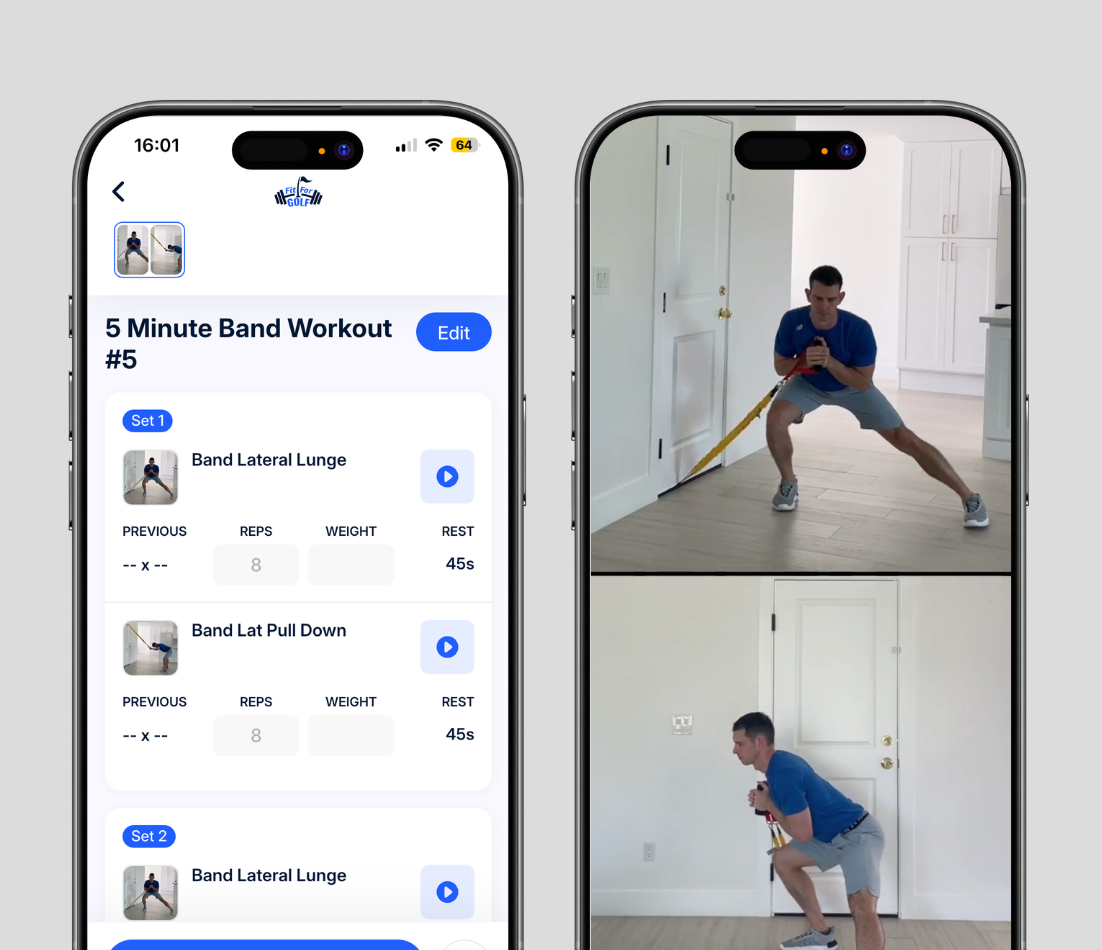

Quick Summary | Est. reading time: 15–18 minutes
- Why club head speed is a critical element of golf potential.
- The key physical, mechanical, and psychological factors that determine speed.
- The importance of viewing club head speed as a trainable skill.
- An analysis of The Stack vs Driver, and how to integrate both.
- Practical volume, frequency, and warm-up suggestions for swing speed training.
- How to monitor on course transfer and use “speed priming”.
- Common mistakes to avoid and what realistic progress looks like.
Designed for golfers of all levels, from high handicaps to Tour players, this guide goes deep on how to increase club head speed and transfer it to the golf course for lower scores.
Developing club head speed is a big passion of mine. I’ve spent a huge amount of time studying the biomechanics and physiology that underpin club head speed, and have years of experience working with players of all ages and levels, including multiple PGA Tour players. In addition to earning a living helping other people increase their speed, I’ve also put a lot of time and effort into increasing my own club head speed, and regularly reach ball speeds close to 190 mph at 5 ’10 and 170lbs.
Once you read this guide, make sure to check out The Fit For Golf Guide to Strength Training.
Whether you’re a high handicapper, PGA Tour Pro, junior or super senior, male or female… I am confident this resource will help you.
Table of Contents
- Why Club Head Speed Matters
- The Determinants of Club Head Speed
- Viewing Club Head Speed as a Trainable Skill
- Speed Training With The Stack vs Driver
- Frequency & Volume of Swing Speed Training
- Monitoring On Course Speed
- PGA Tour Case Studies
- Speed Priming
- Common Mistakes
- How to Get Started With Swing Speed Training
- How Much Can You Gain?
- Club Head Speed, Ball Speed, & Centerness of Strike
- Training For Club Head Speed is Longevity Training
- Conclusion
1. Why Club Head Speed Matters
Club head speed is one of the biggest determinants of potential performance in golf. There is a certain threshold you need to be at depending on your golf goals. Without it, reaching these goals becomes much harder.
Club head speed hugely impacts ball speed, which is the biggest determinant of distance with all clubs. In practical terms, with all else being equal, a gain of 20 yards with the driver requires about 7 mph of club head speed increase. This is a very reasonable increase for most golfers.
It should be noted, improvements in strike location, launch angle, and spin rate can also be transformative for golfers. Once these have been taken to a high degree of “optimisation”, all you’re left with for more distance is club head speed. It’s the governor.
What does this mean from a score improvement or strokes gained perspective?
A 20 yard improvement is worth approximately 0.13 strokes per shot.
0.13 x 12 drivers per round is 1.56 strokes. (1.82 if you hit 14 drivers)
(If you’re not familiar with Strokes Gained you can check out my podcast with Mark Broadie.
The gains don’t end with driver. If a golfer gains 7 mph of club head speed with driver, they will almost certainly become one club longer through the bag. This means one club less from each approach distance. Not only are you closer to the hole, you get to use a shorter and more lofted club on each approach shot than you would have previously from a given distance.
Imagine a typical par 4 at your home course. 20 yards further off the tee and closer to the green is worth about 1.5 to 2 clubs difference in approach shot club. Add in the fact you are now one club longer from each approach distance, and there is likely a 2.5 to 3.5 club difference on your approach shot.
Factor this into every hole of every round (with some exceptions depending on the course). Greens in Regulation (GIR) and proximity to the hole will improve dramatically. If you want to make significant improvements in your handicap, increasing GIR needs to be a key focus.
This is a completely different golfer, capable of a very different style of golf, and very different scores. Thousands of golfers have made this progress. Club head speed is extremely trainable, and worthy of serious attention if you are a golfer committed to improving your scores.
2. The Determinants of Club Head Speed
Physical Capabilities
Mobility and physical power are the big players. Physical power or “explosiveness” is a combination of strength and rate of force development, and those are what we train to get more powerful. The greater your physical power levels are, the more potential you have to create speed. We need adequate mobility to go through the range of motion we desire in the swing.
Swing Mechanics
Club head speed is primarily determined by;
a) The length of the handpath in the downswing
x
b) The average force applied along this handpath
Time applied (a) x average force (b) = the amount of impulse applied to the club.
The higher the impulse, the greater the change in momentum of the clubhead, which we measure as club head speed at impact.
Consider handpath length as a runway. With a longer runway, we have more time to accelerate. This is why hip, thoracic, and shoulder mobility are important. They provide us with the physical requirements for a longer hand path.
Another analogy we can learn from is wedge play. By changing how far we move our hands in the backswing when chipping or pitching we can drastically alter the club head speed at impact, without trying to apply more force. This is due to having more time to apply force during the downswing. We can use this same concept when trying to increase club head speed in the full swing. Usually get your hands to 10 o’ clock? Get them to 10:30 or 11 o’ clock and your club head speed will likely increase.
The average force applied will be dictated by your kinematic sequencing, the explosive capabilities of your nervous system and muscles, and your level of effort.
The information above is describing linear work in the golf swing. There is also relevance to how much angular work is done. This refers to how far the shaft has rotated “around the clock”.
Here is a passage from Sasho Mackenzie’s paper “How Amateur Golfers Apply Energy to the club” that sums up these concepts…
It was determined that linear work predicted 90% of the variability in clubhead speed, while angular work only predicted an additional 9%, and gravity had no predictive ability.
The average force applied in the direction of travel of the hand path was by far the biggest discriminator in separating individuals with different levels of clubhead speed, as it predicted 92% of the variability. From a practical standpoint, knowing that a higher level of average force most likely explains differences in clubhead speed does not suggest a clear path for an instructor, or golfer, trying to increase clubhead speed. The reason is that a higher average force could be the result of several diverse factors such as swing coordination, level of exertion, and the force generating capabilities of the primary muscles involved.
Psychology
Commitment to swinging fast or “letting it go” is crucial. Many golfers leave a lot of speed untapped because they fear losing control. Speed training helps you get comfortable moving the club fast. Counterintuitively, accuracy often improves. This barrier often needs to be broken down both off and on the course. As environment and consequence change, so do comfort levels and commitment.
Club Head Speed – Reverse Engineered is an article I wrote diving deeper into the different determinants of club head speed, and how you can train them.

3. Viewing Club Head Speed as a Trainable Skill
Practice what you want to get better at with a high level of intent and feedback. For speed training, a radar is essential. It is akin to having a stopwatch for measuring sprint times. Without it, you are guessing.
A radar obviously provides feedback and makes it easy to monitor your progress, but it also drives intent, a key element of any speed or power focused training. We become highly engaged in trying to beat the numbers being relayed back to us. It’s essentially a form of gamifying our training.
Speed training is a venn diagram of physical training, mechanics training, and skill building. You will be stimulating adaptations to your physiology, golf swing, and ability to coordinate impact. Contrary to some reports, most players who stick to speed training get more accurate. This is partly due to the coordination benefits provided by swinging at higher speeds than normal, and partly due to the fact that golfers tend to hit way more drivers than they usually would each week, with an ultra high level of focus.
4. Speed Training with The Stack vs Driver?
This is a very common question. The short answer is, if possible, use both!
Speed training tools like The Stack are excellent, but you can make big progress with just a driver. There’s plenty of scope for integrating both, and this is my general recommendation. The Stack in the off season builds the raw materials, while driver and ball work coming into the season trains the specific skill and coordination. Both can stay in the weekly plan, the priority just shifts.
This type of periodised training, different training emphasises at different times, can be applied to all of your training and practice.
The Stack, with its focus on overspeed and overload training, is a great supplement for building more horsepower. View this more as “training”, and doing speed training while hitting drivers as a hybrid between training and practice, as it’s really both. Track & field throwing, which is many decades ahead of golf for the integration of technical and physical development have implemented this type of training for a very long time. They throw a variety of different weighted implements to avoid stagnation and develop slightly different physical and technical qualities.
It’s always adjusted based on strengths and weaknesses and time of season. Golfers can learn from this!
Removing the ball can be very beneficial for golfers who have a hard time committing to swinging fast. Fear of a poor shot outcome, or in the case of beginner and lower skilled golfers, a history of poor shot outcomes often leads to a golfer constraining their swing length and effort in the hope of not being embarrassed or frustrated. In the short term this is understandable and may have merit, but it essentially puts the golfer in a straight jacket, and they never develop a swing with appreciable speed. This hugely limits their long term potential.
Removing the ball and providing a singular goal of “swing this stick fast” gives them a chance to develop a swing that has some speed, without the fear of ball contact! This generally leads to a much more athletic and dynamic swing that has a lot more long term potential.
Of course over time, we need to gradually merge swing speed training and hitting the golf ball. Remember what I said about this being a skill?!
Foam balls can be a nice way to bridge this gap. You get your real driver in your hands and there is a ball to hit, but the attachment to shot outcome is greatly reduced. Driver & foam ball training into a net works nicely, and is a good practical home practice set up. I’ve done this a lot in my back garden. Foam balls are much safer in a back garden setting, and don’t make anywhere near as much noise.
Having a ball present, even its foam, and having our real driver in our hands, presents a different task for the brain and is more similar to real golf. Of course, we need to get comfortable with real balls and real shot outcomes too.
Stack → Driver air swings → Driver foam balls → Driver real balls → Driver real balls on course
This is a progression you can think of from general to specific. One isn’t necessarily better than the other, and you don’t need to include all of these. It can also be adjusted based on personal needs and preferences.
In my experience, golfers who combine The Stack and driver and ball training make the best long term progress. Of course, this should also be done in conjunction with periodised year round workout programs on the Fit For Golf App.
5. Frequency & Volume of Swing Speed Training
Getting started, I recommend 2 to 3 sessions per week, with about 15 swings per session. 48 to 72 hours recovery between sessions is ideal, so every 2nd or 3rd day works very well.
It’s important to be very well warmed-up for these swings, and to do them in a fresh state.
Speed training is much less effective and poses a higher risk for injury if we are fatigued from other workouts, or haven’t recovered from previous swing speed training sessions.
This video goes into detail about integrating swing speed training with other workouts:
You can add 5 to 10 swings per session when progress stalls. In addition to gradually building a higher training volume, which can become important for stimulating continued progress, more swings means more practice. These reps are valuable learning opportunities that we can use to make adjustments, whether those are more global sequencing adjustments for more speed, or smaller micro adjustments for refining face control. This is particularly true with driver and ball sessions, when you are trying to improve overall driving, as opposed to simply maximum speed.
(Again, this is where periodisation becomes important. There is a time and place for all these elements).
Shorter and more frequent sessions benefit the skill building element of speed training. Skill development is enhanced by frequent exposures and recalls, rather than in long sporadic blocks (Shea & Lai 2000, Garcia et al 2019). Shorter and more frequent sessions are also better for reducing fatigue and reducing injury risk.
I don’t really think of speed training in terms of sets and reps like strength training as there is an inbuilt rest between each swing. Make sure you aren’t rushing through balls and getting gassed unnecessarily. I like to take about 20-30 seconds between swings. I’ll hit, watch the shot, gather the tee, tee up the next ball, go behind the ball and walk in and line up, and swing.
So, the pre shot routine doubles as a between swing rest period. After every 8-10 swings or so, you might need a slightly longer break, of a couple of minutes. I generally record a swing on video every 5-10 swings, and reviewing my mechanics will take a minute or so, providing a rest. You don’t want to rest too long, and stay standing and moving around. It’s quite easy to cool down and stiffen up.
6. Monitoring On Course Speed
Monitoring on course club and ball speed data can be very informative. It may sound obvious, but if you’re doing all this training with the goal of seeing progress on the course, shouldn’t we keep track of actual on course data?
You can get a good estimate of progress from where your drives are going on courses you know well, and you might have data from shot tracking apps like Arccos or ShotScope, but there’s something nice about seeing club and ball speed. Shot distance on any given day can be influenced by conditions. Club and ball speed are more stable. These are also the metrics you track in training, so it makes a simple like-for-like comparison.
It answers the question “How well am I transferring my training to the course?”
The Stack or PRGR Radars are absolutely perfect for this. They’re easy to fit in your golf bag and only take a few seconds to turn on and set up. I love doing this on a few drives in recreational rounds (you can’t do it in tournament rounds). It gives you a chance to see what difference, if any, there is between your training and on course speeds.
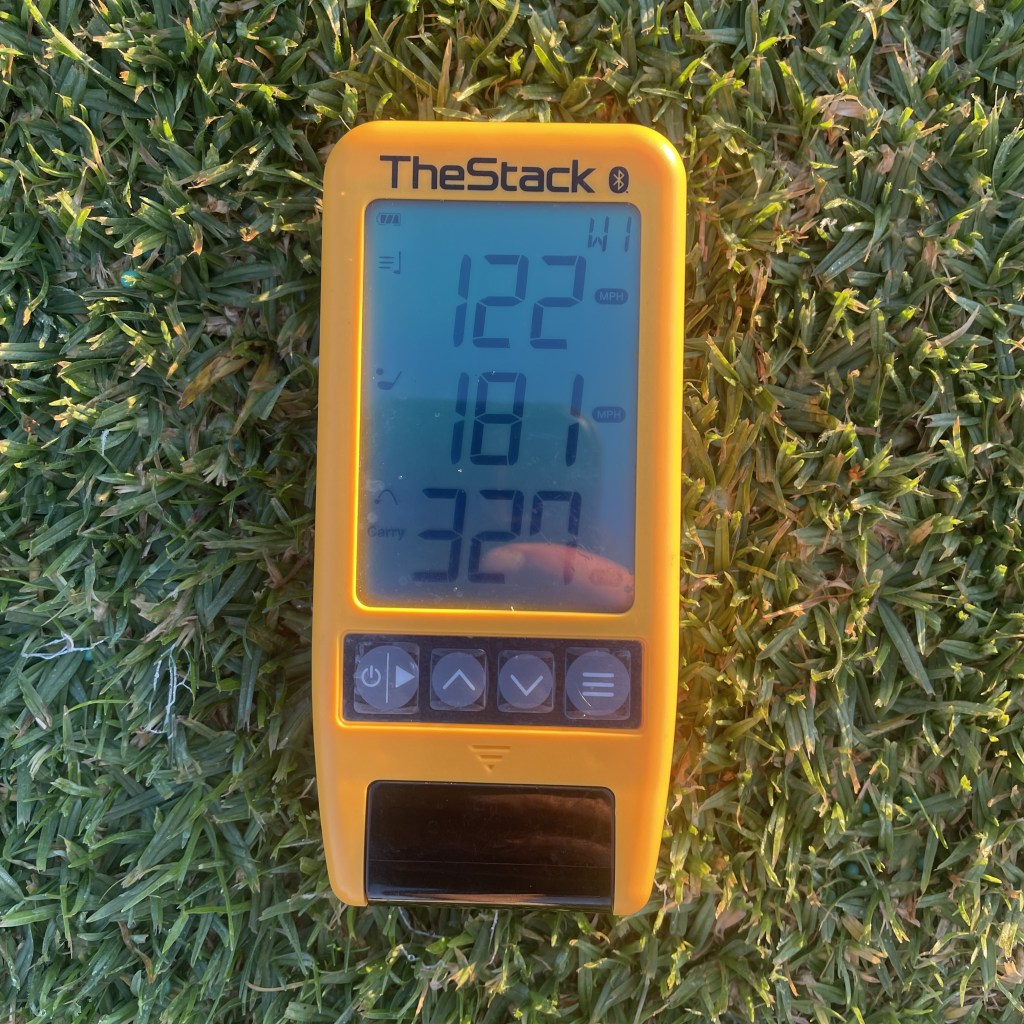
If there is a big difference between your training speeds and on course speeds, it could be a sign you are being too fearful and holding back too much on the course. In this instance using the radar as external feedback can be a great commitment tool.
”I know from training I can comfortably hit ____ mph, let’s see it here on the course!”
For example, if in your driver training you are comfortably hitting 105 mph club head speed and 155 mph ball speed, but on the course you’re seeing 97 mph and 143 mph, you know there is a big speed gap. It’s most likely down to comfort and commitment. Without measuring you may have been oblivious that you were holding so much back on the course.
It’s normal for there to be some difference between on course speeds and the speeds you see in your speed training. How much of a difference depends if we’re comparing “absolute max” or swings where we are hitting driver and ball and trying to slightly push the needle.
Over time, I think the gap between these starts to diminish anyway. Oftentimes, “trying harder” doesn’t actually result in higher club head speed. When we’re speed training and hitting multiple drivers in a row, we tend to get into a rhythm and move faster than when we swing a driver once every 15 or so minutes on the course. There’s also a small difference in intent and comfort. On the course we might sacrifice some speed for a little more control. This may change as coordination at high speeds improves though!
If you compare your on course speeds to your driver training swings (not max-effort swings, but fast controlled ones), there shouldn’t be a big gap. About 2 to 3 mph difference in club head speed is normal. Some see no difference, and some are faster on course due to adrenaline.
If you’re comparing on course driver swings to all out max speed training swings, a gap of about 5 to 7 mph is reasonable. If the gap is bigger, your training swing probably isn’t a good representation of what you use on the course.
In my opinion, speed training shouldn’t go fully down the hole of swinging in any way necessary just to get numbers up. I used to do this, and it wasn’t particularly helpful. Depending on the level of player, and mechanics employed, you may be working on something that you will never transfer to the course. This is again player and time of season dependent. There is a place for experimentation and exaggeration, but you also need to remember the purpose of your training.
Always ask yourself “does this provide beneficial transfer?”
7. PGA Tour Case Studies
I had first hand experience of this lack of transfer about five years ago, working with a PGA Tour player. His goal was to increase club head speed and ball speed on the course to help him shoot lower scores. This player had a big gap between his swing speed training and his on course swing speed, about 7 to 10mph.
As we worked through the process, we realized the swings he used for speed training had deviated too far from his on course mechanics. The increases in training speed weren’t transferring to the course because the swings used in each environment were very different movement patterns. The speed training sessions had basically turned into “Long Drive” contests.
Since then, this player has made significant progress with his on course club head speed and ball speed. There’s now much less difference between his driver training speeds and his tournament speeds. Because he now uses mechanics he trusts, there’s no longer a big gap.
Another PGA Tour player I’ve worked with added great context to his driver speed training. He made huge progress with his club head speed, ball speed, and strokes gained off the tee. Over the course of two seasons he gained 6mph of average club head speed in tournament play, and increased his fairways hit % from 57 to 60%.
He followed a typical prescription I would suggest in the off season for a Tour player.
He completed four sets of eight balls, with about 30 seconds between each ball in a set of 8, then about 2-3 mins between each set. This was done 3 x week, on non consecutive days.
The added layer of context he used, which was his idea, was hitting the balls down a practice hole at his course. This meant he was hitting down an actual hole on a golf course. After each set of 8, during his rest period, he drove a golf cart down to collect the balls. This allowed him to check dispersion.
This confirmed his high speed swings were very accurate, actually more accurate compared to when he tried to take speed off for more control. Seeing that helped him to commit on the course.
The next steps in this progression are becoming diligent with measuring speeds during practice rounds where you’re only hitting one or two balls off each tee, and monitoring tournament data. The goal would be to see the training speeds leading to better practice round and tournament round performance. This is another example of general to specific preparation.
Like everything in golf, we move through stages of development.
8. Speed Priming
Speed priming is a way that you can get your body up to maximum speed in a short period of time. When you’re doing a driver or stack session, you’re hitting multiple swings in a row. Your body is “in a groove”, your nervous systems and muscles are amped up to full capacity, and there’s no consequence to the shot. That allows you to reach your top speeds easily.
When you play golf, it might be early morning, cold, slow pace of play, or you just haven’t made a fast swing in a while. It’s easy to lose that feeling of top speed. There are some “hacks” we can implement to combat this situation.
Mastering Weather Conditions with Marty Jertson
Pre-Round Priming
In pre round priming, the idea is to assign between 5 and 10 balls in your warm-up to swing the driver with high intent, maybe a little faster than you would on the course. This gets your nervous system and muscles firing at full speed, and can build comfort and confidence.
After those swings, dial back down to your normal driver speed for 5 or so swings and finish your warm-up there. If you’re playing multiple tournament rounds or practice rounds in a week, this gives you a small daily dose of speed work that maintains or even builds your speed without extra sessions. Low dose, high frequency practice of a specific skill you are trying to improve.
I regularly recommend this to tour players and competitive amateurs.
This approach works really well for competitive players who already have structured warm-ups and a lot of time available.
I play most of my recreational golf at first light, and don’t hit balls beforehand. I am guessing you don’t have a huge amount of time to warm-up either. I make sure to go through Dynamic Warm-Up #1 from the Fit For Golf App at home before I drive 15 minutes to the course. Before teeing off, I make about 3 sets of 8 driver swings, while waiting near the first tee, ramping up the speed on each set. This doubles as “speed priming” but it’s also a good way to get fully warmed up and loosened out. If you hit balls before you play, you can simply follow the protocol outlined earlier, 5-10 drivers, letting it rip!
Pre-Shot Priming
Pre shot priming is especially valuable on the course. You might go 15 or 30 minutes between drivers, sometimes longer. If you only make a full driver swing every half hour, it’s hard to be at full speed when it’s time to hit.
Padraig Harrington is a good example of someone you will see using pre-shot speed priming. You’ll see him doing very fast, aggressive swings on tee boxes before hitting the driver.
This will excite his nervous system and muscles, getting them ready for high output.
In simple terms, you’re “blowing off the cobwebs” a little bit.
All it takes is one or two aggressive practice swings where you focus on making the club swish loudly. Then you carry that same feeling into your actual shot.
I like to do one aggressive practice swing using the “Pump Drill” before hitting a driver on the course. I think it helps my overall sequence as well as my speed.
You don’t want your “pre-shot priming” to take too long or be fatiguing. Just make sure your body is ready for a fast, athletic move. These priming swings are small details, but they help you access the speed you’ve trained. The foundational work is your physical training and speed sessions.
9. Common Mistakes
The biggest mistakes I see in speed training are too much too soon, insufficient warm-ups, and not trusting the process.
Too Much Too Soon
It’s common for golfers to get a burst of enthusiasm when they begin speed training. This can lead to them doing way too many swings relative to what’s needed for progress, and more importantly, what they are physically prepared for. In this scenario the golfer doesn’t make any more progress than they started with a more moderate volume, but must deal with a much higher amount of fatigue and increased injury risk.
In all aspects of physical training it is more sensible to start on the conservative side and slowly build up. It’s much easier to add little amounts over time rather than overdo it early.
A mismanagement of speed training volume and frequency is the biggest reason for injuries during swing speed training. The next biggest issue is not warming up thoroughly enough.
Insufficient Warm-Up
Adequately warming up is essential for reducing the risk of injury and performing at your best on that given day. A full and thorough warm-up before speed training is non negotiable. Do not skip it or cut it short. If you are pressed for time, cut down on the number of swings you make in the speed training session, do not skimp the warm-up!
In the Swing Speed Training section of the Fit For Golf App, there is an option to be guided through a warm-up before you begin. I always choose Dynamic Warm-Up #1, which after memorising takes about 8 minutes. I then perform a lot of swings with my driver (or stack), progressing from slow to medium to fast. A simple way to do this is 3 sets of 5 swings. With 60 seconds or so between sets. A slow set, a medium set, and a fast set.
This “Pump Drill” shown above is a favourite of mine to do in warm-ups. I do this for 3 sets of 5 instead of “normal swings”. It’s a good warm-up and speed drill and they flow a bit better than breaking up swings, as I transition from the follow through of one swing into the “first pump” for the next swing.
You should have a little bit of a sweat going and feel noticeably warmer by the end of this process. A good sign you’re adequately warmed up for your speed training is that your first few balls in the session are almost as fast as the peak speeds you hit in the session. If there is a big gap, or you clearly improve throughout the session, it’s a sign you weren’t fully warmed-up.
Inserting your speed training at the end of or during a range session is a practical way to ensure you are well warmed-up without needing to go through the whole warm-up process just to speed train. There is a sweet spot of being well warmed-up but also not fatigued. You will need to judge this for yourself.
If I’m in a “speed training block” where I’m really trying to make progress with speed, I tend to do speed only sessions. I go through dynamic warm-up #1, 3-4 sets of 5 swings of the pump drill trying to get faster on each set, and then hit approximately 30-40 balls. This is time consuming and would easily take me an hour. I typically do this 2 x week in the winter months.
On the contrary if I’m in a period where I’m more focused on maximising my practice time to sharpen up on course scores, I might not want to devote 1-2 hours a week solely to speed training. In this scenario, I would just hit about 10 drivers at the end of each practice session, which adds almost zero time.
Not Trusting the Process
People start working on speed, maybe change their mechanics or intent, and in the early stages their dispersion gets worse. They hit some shots they’re not used to. Because of that, they back off and decide speed training isn’t for them.
In my experience, most players who stick with it and train sensibly see really good outcomes. You’ll have some messy sessions along the way, but the long term gains are worth it.
A good example of someone who came through this experience is a golfer named Rory McIlroy. (I have not worked with Rory or have any inside info, I am purely going from what is readily available online).
In September 2020 Bryson DeChambeau won the US Open at Winged Foot by six shots. During the 2019-2020 season, Bryson averaged 125.00mph club head speed. This increased to a 132.25mph in the 2020-2021 season, a whopping 132mph of club head speed. A whopping 14mph increase from the 2018-2019 season, and the highest ever club head speed recorded for a PGA Tour season, by a wide margin. His speed gains and results were receiving a lot of attention!
Rory lost about 2mph of club head speed during the COVID break. At the time, based on his social media activity, he was focusing a lot on Pelton workouts, and seemed to have lost quite a bit of mass. In the 2019-20 season, Rory averaged 118.88mph club head, 30th place in the PGA Tour rankings, which is a very unusual position for him. In the following 2020-21 season, he gained 4mph, averaging 122.87mph, and moving up to 9th in the club head speed rankings.
In March of that season Rory shot 79-75 to miss the cut at the Player’s Championship and spoke about how he felt working on speed, which he increased by 4mph, had hurt his swing.
He discusses it in minutes 1-4 of this video.
This video was about 6 months after he said he started working on speed. Quite a short period of time for an already extremely fast player to gain 4mph and feel comfortable using it.
So, did Rory cut back on his speed and start swinging slower? Absolutely not! In fact 4 years on, Rory is swinging faster than he was at the time he made this video!
Based on the statistics since then, it seems he has kept working on it, and got through the initial struggles. In the 2024 season Rory averaged 123.6mph club head speed, and in the 2025 season he averaged 123.33mph. This put him 6th and 12th in the PGA Tour club head speed rankings.
From following the social media accounts of the PGA Tour & DP Tour who regularly show Rory on the range hitting over 190mph ball speed and 127mph club head speed I am confident he continues working on his speed.
Something also very evident over this time frame is how much mass Rory has gained. I estimate he has gained about 15-20lbs, with a decent proportion of it being lean tissue. I have no doubt that developing a bigger and more powerful frame made Rory’s desire for a certain club head speed more attainable with mechanics he is comfortable playing with.
10. How To Get Started With Swing Speed Training
The first thing you need is a radar. As noted, The PRGR or Stack Radar are great options.
Stack or Driver?
You don’t have to get The Stack System. I’ll be completely honest, I’m an ambassador and affiliate for The Stack. If you buy one with my code, I get a commission. That said, I know from experience golfers tend to make excellent progress training with The Stack System.
It’s great for getting comfortable swinging fast, building power, improving mobility, and learning to move athletically. It’s well structured with ideal volume and frequency (2–3 sessions per week, usually 18–40 swings per session).
They’ve also done a fantastic job gamifying it and individualizing progress.
Even if you decide to purchase The Stack, you still need to include driver and ball work to develop the specific skill and maximise transfer to the course. Increasing club head speed is ultimately about increasing ball speed, and contact quality is a big part of that. Swinging The Stack faster and hitting the driver longer and better are different, but complementary skills. The best plan includes both.
If you want to start with just your driver, that’s completely fine. You can swing your driver, hit foam balls, or hit real balls.
Swing Speed Training on The Fit For Golf App
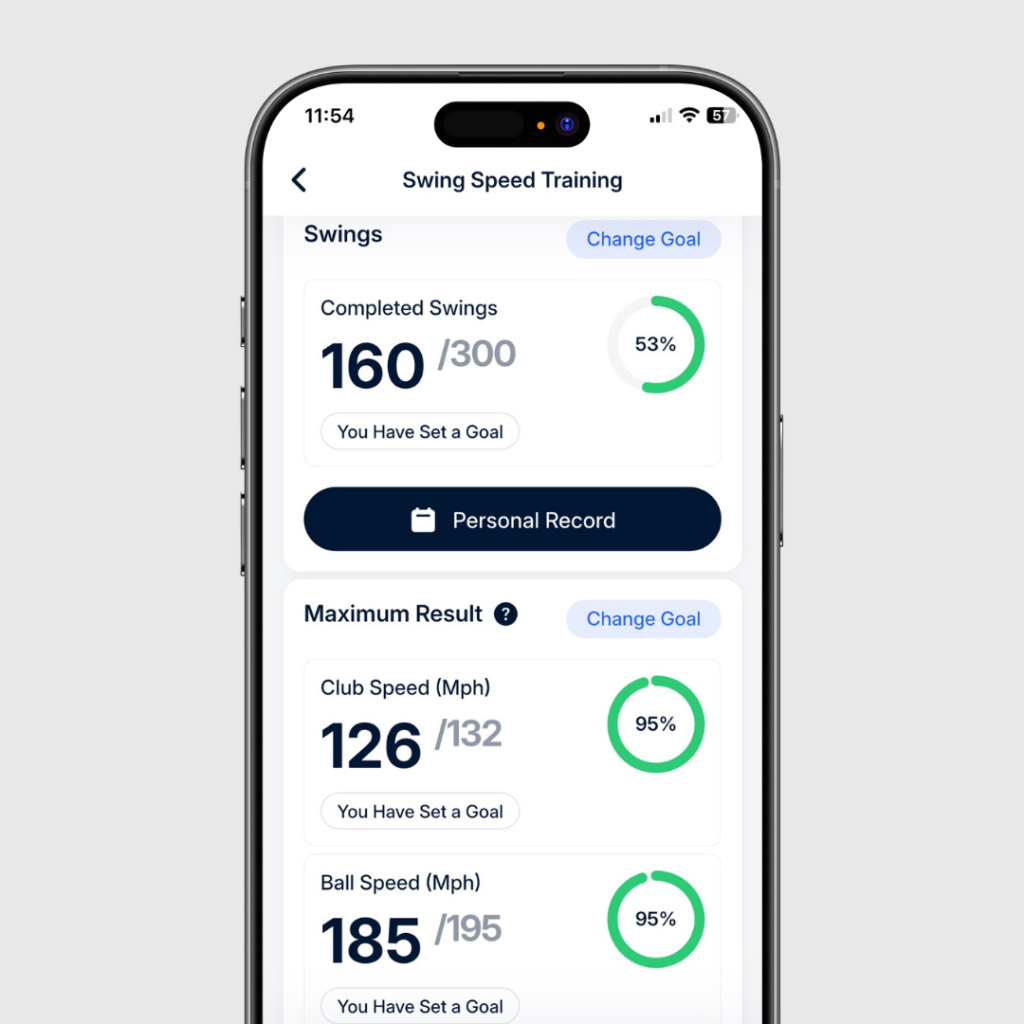
If you’re logging driver swings, you can now do this directly in the Fit For Golf App in the “Swing Speed Training” section. This feature has become very popular and users that are consistent with their training are making great progress.
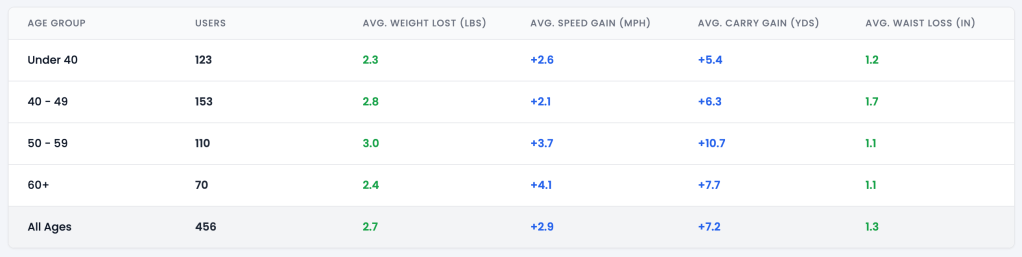
A cohort of Fit For Golf App users are currently 4 weeks into “Gain 20 yards – Lose 20 lbs” 12 week challenge. You can see their results to date here. Pretty good for just 4 weeks of training!
A nice element of this feature is the ability to set goals for average & maximum club head speed (and ball speed, and carry distance if you wish), and track your progress towards them. You can also set a goal for how many swings you want to complete each month, which provides some consistency motivation!
11. How Much Can You Gain?
Almost all golfers who haven’t done speed training can gain about 5mph of average club head speed, roughly 12 to 15 yards within three months.
Many can gain 10mph (25–30 yards) over a year, especially if they’re also strength and power training.
There is no question that combining physical training on the Fit For Golf App to improve mobility, strength, and explosive power in conjunction with specific swing speed training is better than either alone.
12. Club Head Speed, Ball Speed, & Centerness of Strike
All the talk in this article so far has been about club head speed, but ball speed is what we’re ultimately trying to improve, as this is the biggest determinant of shot distance.
Club head speed provides the potential, but as you likely know, the same club head speed can provide a whole range of different ball speeds and shot outcomes!
Smash factor (ball speed divided by club head speed) gives a good indication of how centered the strike is. In simple terms, the closer to the middle of the face you hit, the higher your smash factor and the more energy is transferred to the ball. The reverse is also true.
It’s easy to see your smash factor number from your radar, but unless you have a top of the line one, it doesn’t tell us why the smash factor is what it is on a particular shot. Highly experienced golfers may be able to accurately determine where their strike location is on each shot, but this is not always the case. Spraying foot powder or dry shampoo on your driver face for simple strike feedback can be helpful to see your strike location pattern, and make practice very engaging. You can see how close to the center you can cluster 5-10 shots, then reapply a light dusting of spray and try again.
A lot of golfers have a strike tendency, i.e they might be heel or toe biased. You can use this training to get a feel for shifting your pattern away from your tendency, a great way to improve face control. In the image below, the golfer tends to have a low heel tendency. In this set of balls, the goal was to not have any shots strike the heel side of center.
Adam Young provides further info on this in this article.
While smash factor is a helpful metric, be careful of going the “optimisation rabbit hole”. For one, different radars all measure impact slightly differently and will give you slightly different metrics.
The ball you are using also makes a huge difference. For example, with certain range balls you may only be able to achieve a smash factor of 1.4. If you flush a couple right out of the middle, you will have a good idea of what your maximum smash factor capability is with your radar & ball combo. I’ve also noticed that as I have gained club head speed my ball speed on mishits is about the same as what it used to be when I flushed one. You’re always going to be dealing with a certain amount of mis hits. In these scenarios having plenty of speed is very helpful.
Launch angle and spin rate also have a big influence on distance. You can reference the Ping chart for optimal launch and spin combinations for maximising distance. Just remember the best players aim to optimize for real golf not just max distance on a launch monitor.
There is a lot of info in this section. The two main takeaways are to continue raising your club head speed and continue improving your ability to hit the middle of the face.
Every 5mph or so, you may want to check that your driver is still the correct spec for you.
13. Training For Club Head Speed is Longevity Training
The type of physical training we must do to maintain / increase club head speed as we get older – primarily strength and rate of force development – is the exact same as what we must do to slow down / reverse the loss of muscle mass, strength, and power as you age. This is a huge win-win!! You are training for better long term golf & all round health!
Improving mobility, strength, and power is universally good. While increasing club head speed and lowering your scores is fun, I’m sure staying athletic and independent as you age is just as important!
14. Conclusion
Speed is a skill and a physical capacity. You can train both at any age.
Work on your strength and explosiveness.
Practice swinging fast with radar feedback.
Be patient, track progress, and don’t fear temporary messiness.
Over time, your driving distance, ball striking, and overall athleticism will improve.
It’s one of the most rewarding areas of golf training to invest in.
Fit For Golf App Success Stories
61-year-old, 2 hcp golfer Eric used the FFG App for 6 months:
- Swing speed up from 97 → 109 mph
- Better hip, ankle & torso mobility
- Friends noticing his improved turn
“It’s been a game changer for my distance and movement.”
Since using the Fit For Golf app, Brian has:
- Gained 12mph club head speed
- Lost 10lbs
- Dropped his handicap by 5
- Crushed drives 300+ yards!
Related Articles
- Club Head Speed – Reverse Engineered
- Why I Have Partnered With The Stack System
- Club Head Speed Training: Individualisation & Overcoming Plateaus
- PGA Tour Player – 6mph Club Head Speed Gain
- Common Speed Training Pitfalls
- 5 Minute Golf Warm-Up to Loosen Mobility and Improve Your Swing
- 70 year olds stronger than 25 year olds?