
Specific elements of your physical fitness play a huge role in determining your golf potential.
The ability to create sufficient club head speed for your goals is a critical priority. Your ability to produce this speed is heavily dependent on your “specific fitness” for the task. You can only swing as fast as your current physical capabilities allow. Thankfully, these capabilities are highly responsive to training.
Club head speed is a key element of golf performance because it is massively influential in what you can make the golf ball do. It is the limiting factor in shot distance with all clubs. If you want a full breakdown of how to specifically train your swing for more speed, make sure to read Swing Speed Training – The Fit For Golf Guide.
In simple terms, there is a very strong relationship between how fast you can swing and how far you can hit the ball. The further you hit the ball off the tee, the closer to the green your approach shots will be. The closer your approach shots are, the easier it is to hit the ball on the Green In Regulation (GIR) or near the GIR (nGIR).
Hitting more GIR (and nGIR) is critical for significantly lowering your scores, and is a huge differentiator between players of different scoring levels. Just take a look at this chart from The Grint.

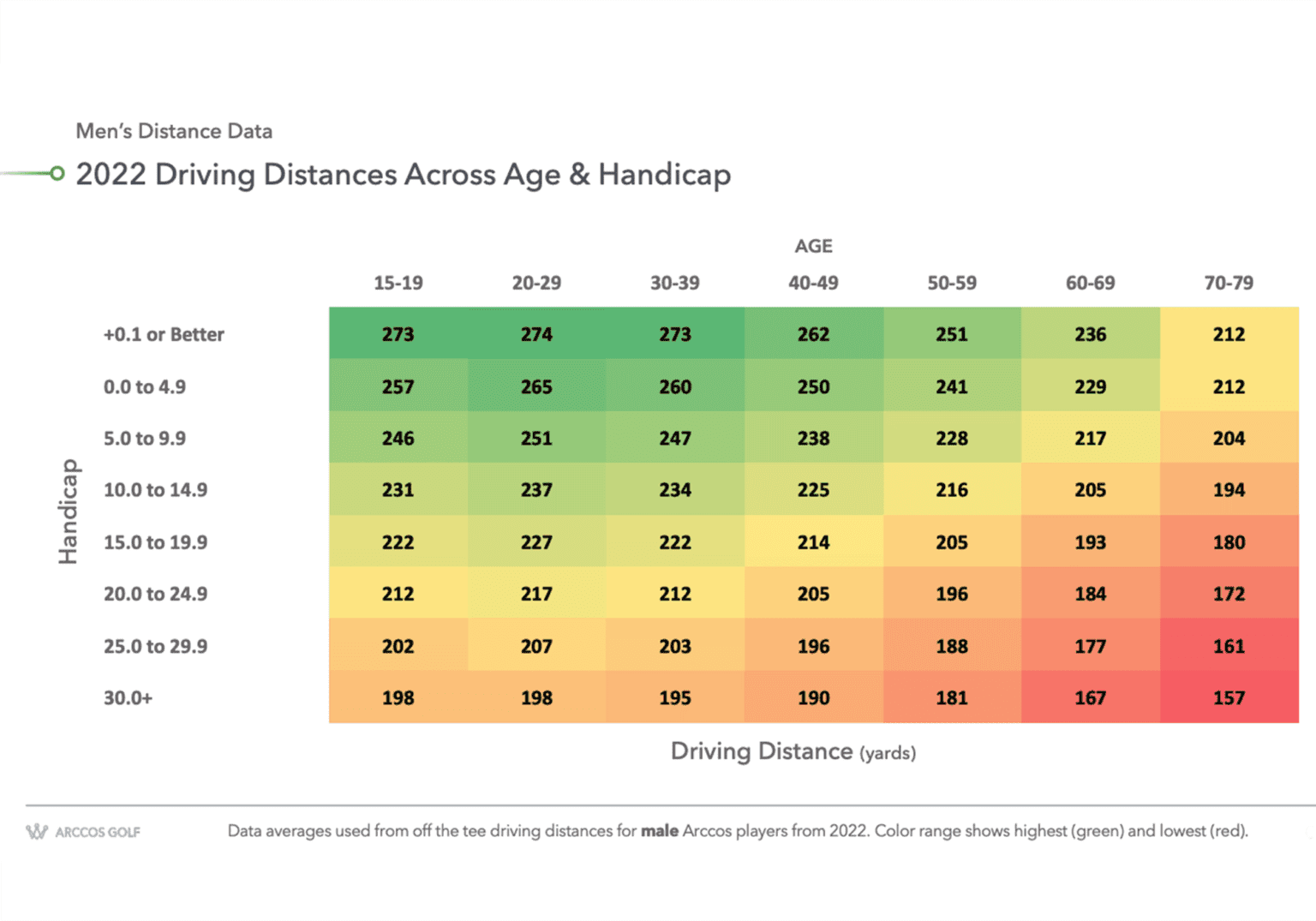
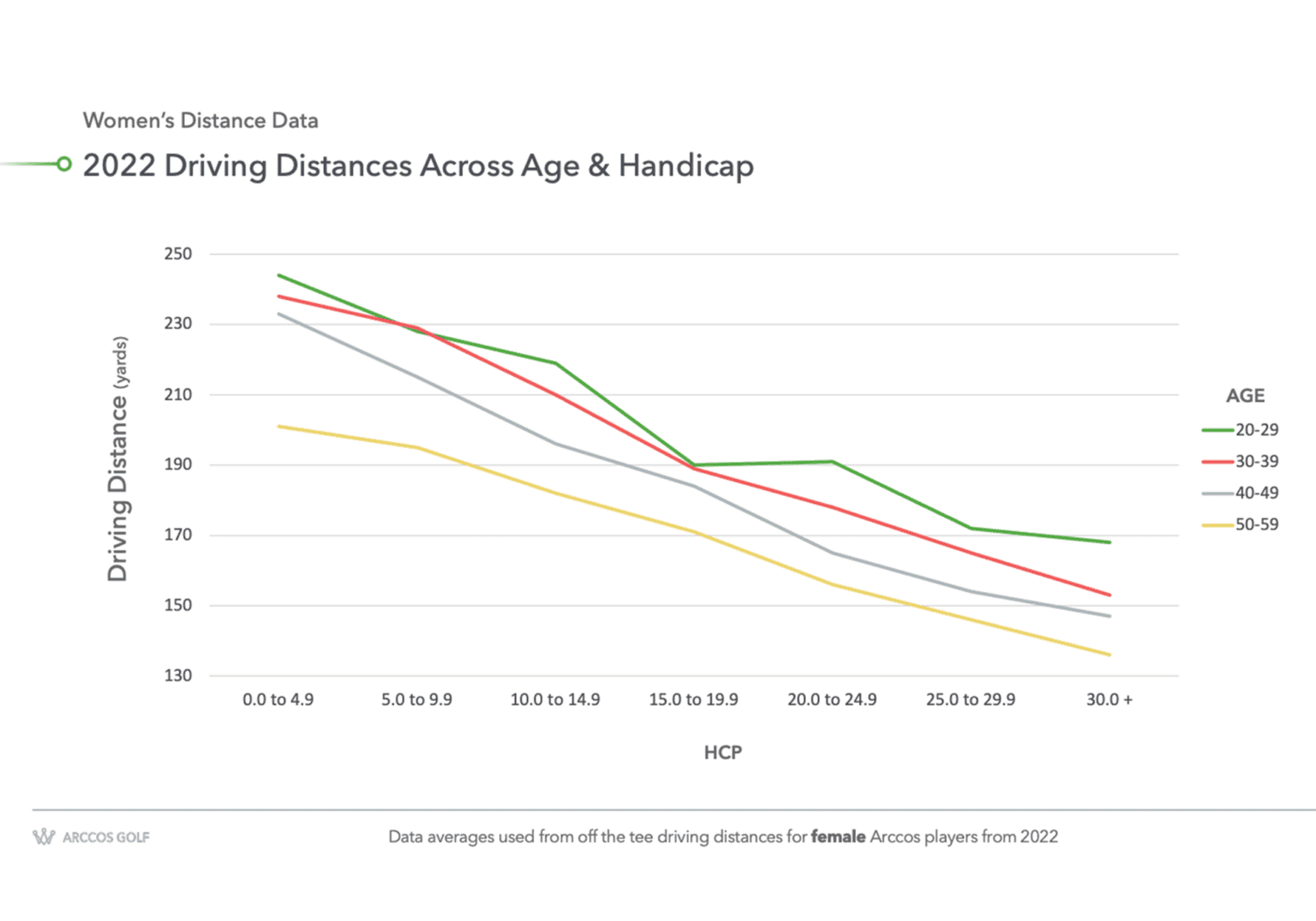
Many golfers have a specific distance they would like to be able to hit their driver. For every distance, there is a minimum club head speed you must be able to generate. There is also huge amounts of data showing that there is a very strong relationship with club head speed, driving distance, and handicap / scoring level. This is because as mentioned, it makes hitting greens easier, whether it be on par 3’s, 4’s, or 5’s.
The data below from Arccos, the shot tracking and statistics system, illustrates this nicely for both males and females.
While being able to drive the ball closer to the green is extremely valuable, club head speed is also critical for approach play.
More club head speed on approach play provides the opportunity to use shorter and more lofted clubs from every approach distance. This makes it easier to get the ball up in the air and stop on the green, as well as reduce sideways dispersion. Are you sick of taking a headcover off on par 3’s or for second shots on par 4’s?
This “double whammy” effect of club head speed helping on both driving and approach play can really change the type of golf you play.
When golfers put some work into gaining club head speed it is not uncommon for them to gain 5mph in a couple of months, and up to 10mph in 6 months. For the purpose of this example let’s practically split the difference at 7mph, which is a VERY COMMON gain.

Each mph of club head speed is worth approximately 2.5-3 yards of distance, with all else being equal. This would equate to 18-21 yards of driving distance.
Anyone who gains this much club head speed with their driver will also gain some (but not as much) speed with every club through their bag. Becoming one club longer through the bag would certainly be expected. Most golfers have about 10-13 yards between each iron / hybrid in their bag.
Let’s apply this gain to a standard par 4 and see what it could mean for how your approach club into the greens at your regular courses might change.
With 7mph of extra club head speed you are looking at being approximately 20 yards closer to the green. This is close to a 2 club difference for most golfers. You will also be one club longer from every approach distance.
This is the difference of hitting an 8 iron instead of a 5 iron, or a gap wedge instead of an 8 iron.
Think this would make the game easier? The advantage is magnified further out of the rough, with extra club head speed getting through the rough better and allowing you to use a more lofted club.
Also consider hitting one club less into 4 or 5 par 3’s per round, and getting up closer to, or on, a couple of par 5’s in two!
This is the advantage of more club head speed, and it’s very low hanging fruit for the vast majority of golfers. Amazingly, many golfers also have room to improve both their club head speed and launch conditions at impact, which can multiply distance gains even further. More speed + better strikes = huge improvement.
We want to build as much speed as we can from where we currently are, then delay the decline due to aging as best as possible. How we train plays the biggest part in this.
I know what you might be thinking, “better short game and putting is the fastest way to lower your scores”. This might actually be true. You may be able to knock some strokes off your score quickly with improved play on and around the green. The amount you can lower your scores solely with short game and putting improvements is generally quite limited however.
Additionally, in general, shots from OUTSIDE 100 yards contribute about twice as much to scoring differences between players of various skill levels compared to shots from INSIDE 100 yards (including putting). This is covered in Mark Broadie’s book Every Shot Counts, and has been shown by popular stat tracking systems like Arccos and ShotScope as well.
Arccos recently published an article documenting the journey of 14 golfers from 5 to scratch, and broke down the average improvement in each category of the game.

As you can see from the info above, hitting more GIR is key, and hitting the ball closer to the green off the tee makes this a lot easier. Improving the specific fitness qualities relevant to the golf swing will make both of these a lot easier!
PS – This is going to get a lot harder with age if you’re not actively fighting against the natural biological decline of muscle power.
If you want to know exactly how you should train to gain club head speed, and slow or even reverse the decline with aging (for a while), try a 7 Day Free trial on the Fit For Golf App.
Thousands of golfers just like you have made huge progress!