
In Part 1 of ‘The Science Of Speed‘ series I gave a primer on slow twitch and fast twitch muscle fibers. As a quick summary, muscle fibers are generally classified into three categories.
Type 1 – Slow twitch
Type 2a – Fast twitch
Type 2x – Extremely fast twitch
We all have a different proportion of these fibers in each of our muscles. It is genetically determined and it has a huge bearing on our potential in activities that are on either end of the endurance or speed continuum. You will not find someone in the 100m Olympic final with a high abundance of slow twitch muscle fibers in their legs, and you won’t see a Tour De France Champion with a high proportion of fast twitch fibers.
While the muscle fiber type classifications outlined above are the ones commonly cited, they don’t tell the whole story. There is not only the presence of type 1, type 2a, and type 2x fibers, but also hybrid fibers. These are single muscle fibers that display characteristics of more than one fiber type. They are essentially a mixture. Hybrid fibers generally follow the “nearest neighbor” phenomenon, in that they almost always display characteristics of the fibers closest to them in the continuum.
For example it is much more common to see a type 1 / 2a hybrid, or a type 2a / x hybrid than a type 1 / 2x hybrid.
So, to summarize, we have pure type 1, type 2a, and type 2x, fiber types and hybrid fiber types.(1)
An interesting research and training question is, “can we convert fibers from one type to another with specific types of training”?
A review paper by Plotkin et al 2021(2), looked at how muscle fiber types are investigated and classified, and if fibers can shift or change type, with different forms of training.
Something I want to make clear is that from a practical standpoint, we don’t really care about fiber type shifts. We care about changes in how we can perform. Changes in performance will certainly not be solely determined by fiber type. Additionally, accurate profiling of fiber types has many challenges, and unless we get regular muscle biopsies done, we won’t know about any of these conversions going on. We will be able to measure changes in performance though!
That’s not to say shifts in muscle fiber types isn’t important, it’s just that we need to remember we are not chasing a certain fiber type proportion, we are chasing performance changes.
Here is some summaraised research from the Plotkin et al 2021 paper(2), looking at what different types of training does in terms of muscle fiber type shifting.
“Traditional” Strength Training
The current literature indicates that resistance training performed at slower speeds due to the use of relatively high loads (>70% of one-repetition maximum) produces a shift from 2x and 2x/2a hybrid fibers to more of a pure 2a type, with little effect on type I fibers. The author notes it is important to remember this is in the timeframes used in these research studies, which is generally 6 to 12 weeks.
However, there are ways this shifting of type 2x to 2a can be minimized that do not sacrifice strength or hypertrophy gains. If we can accomplish this it is highly likely that we will develop strength and hypertrophy in a way that is more useful in high speed activities, like the golf swing.
If you’re interested in how to train specifically for more club head speed, make sure to read Swing Speed Training – The Fit For Golf Guide.
These include methods like cluster training (as used in the Mass program on the Fit For Golf App) which avoid big drop offs in repetition speed, lower rep sets, avoiding failure, lower training volumes, and minimising fatigue. Velocity Based Strength Training (VBT), which is not the same thing as “high velocity training” is something that can also be used. This requires technology like a Virtruve to measure repetition speed, and is beyond the scope of this article.
In general, when training with the ultimate goal of improving force in explosive activities, we want to structure our strength and hypertrophy training in a way that minimises the negative effects certain training styles can have. The typical high volume, pump chasing, bodybuilding split, is simply not a sensible choice.

Combining Strength & Power Training
Liu et al(3) performed an interesting study where they had two groups of resistance trained males split into two different groups. In one group the subjects performed 5 sets of 3 reps of bench press with the maximum load they could lift. Based on the info in the study I think they had a 6 minute break between each set. They did this three times per week on Monday, Wednesday, and Friday. This was the Max group.
The other group performed a combination of heavy strength training and higher speed ballistic type training. This group was called the Combi group. On Monday, they performed the exact same training session as the Max group. On Wednesday they performed 5 sets of 10 bench press throws on a smith machine with 30% of their 1RM, and on Friday they performed 5 sets of 10 ballistic style push-ups. For the Wednesday and Friday sessions they rested 3-4 seconds between each repetition, and then 6 minutes between each set.
The study was 6 weeks long, and they measured the fiber type proportion in the triceps before and after the study.
In the Max group:
Type 2X proportion decreased from 33.4% to 19.5%
Type 2A proportion increased from 49.4% to 66.7%
Type 1 proportion decreased from 17.2% to 13.8% (not statistically significant)
In the Combi group:
Type 2X decreased from 34.1% to 28.1% (not statistically significant)
Type 2A increased from 47.7% to 62.7%
Type 1 proportion decreased from 18.2% to 9.2%
Note worthy: The Combi group maintained 10% more type 2x fibers than the Max group, and had a bigger decrease in type 1 fibers. So, at the end of the study, the combi group had more combined type 2a and 2x fibers in their triceps, and less type 1.
One repetition Maximum Bench Press on a smith machine, and maximum barbell velocity on a smith machine bench press throw of 17kg / 37lbs were also calculated before and after the 6 weeks of training.
The Max group increased their bench press on average by 6.7% compared to 6% for the Combi group. The Max group increased their maximum velocity in the bench press throw by an average of 0.07 m/s compared to 0.1m/s for the Combi group. The authors include that only the increase for the Combi group was statistically significant, but the difference between the two is very very small.
Similar results showing the important fiber type shifting and performance differences between heavy, fast, and combined training have been seen in other studies.
I was a little bit surprised that the Combi group didn’t outperform the Max group by more in the maximum velocity bench press throw based on the results of the fiber type shifts, but there could be a number of reasons for this.
It is worth noting that pretty much all training programs tend to result in some shifts from type 2x towards type 2a (or similar hybrids). Even if the training program is largely based on fast / explosive type activities. Type 2x fibers are so fast to fatigue it seems that once training commences they seem to start to shift towards type 2a. This doesn’t mean that performance cannot be improved. It’s quite a complicated area 😄.
Endurance Training
Endurance training leads to a muscle fiber type shift towards a slower type. This makes perfect sense from a specificity standpoint, as slower fibers are best suited to endurance type activities.(2)
It is also evident that concurrent training (where endurance training is done in the same training program as strength and / or explosive training) negatively impacts the benefits on explosive / speed outcomes.(4)
The volume and type of training is very important though, with higher volumes of training that elicit more muscle damage being more of a negative influence on explosive capabilities. For example endurance running will likely have a bigger impact than cycling, due to the increased muscle damage from running versus cycling.
A common question amongst “lifters” / gym goers is how will endurance training or “cardio” impact their results. These people are usually more interested in how it will affect their strength and muscle gain as opposed to speed / power gains.
The negative effect of endurance training on speed & speed training is greater than the negative effect on strength and hypertrophy. It has a very minimal effect on strength and hypertrophy, depending on the volume, intensity, and timing of each of the training elements.
Concurrent training hurts speed the most, strength next, and has the least effect on hypertrophy.
Chris Beardsley did a fantastic post on this topic(5).
Context Is Key
Most of you reading this are amateur golfers interested in club head speed, but also general fitness, health, and longevity. While research, and a reasonable understanding of physiology makes it quite clear that we can’t absolutely maximse our speed capabilities whilst also maximising strength training and endurance training, these are essential for overall health.
With a well designed training plan, the negative effects will likely be very small, or maybe even hard to detect. This really depends on how much focus is put on each area.
As I note in a lot of my articles, beginner trainees can improve everything at once, and the more advanced and closer to your potential you get, the harder progress in a particular fitness quality becomes, and the more specialised you may need to get.
In the vast majority of cases, you should be focusing on high speed explosive exercises, heavy strength training, and endurance training across your training week. The benefits from each for general health and quality of life are too important to leave any of them out of your routine.
A common question I get from golfers is that they have plateaued in their speed training, and despite consistent hard work, are not getting faster. This is when an audit of your training routine and considering how different types might be interacting in a way that is not helping your goal may be very valuable.
In these scenarios it is not a case of needing to stop strength training or endurance training, but making tweaks to the volume, intensity, and scheduling of the different training elements.
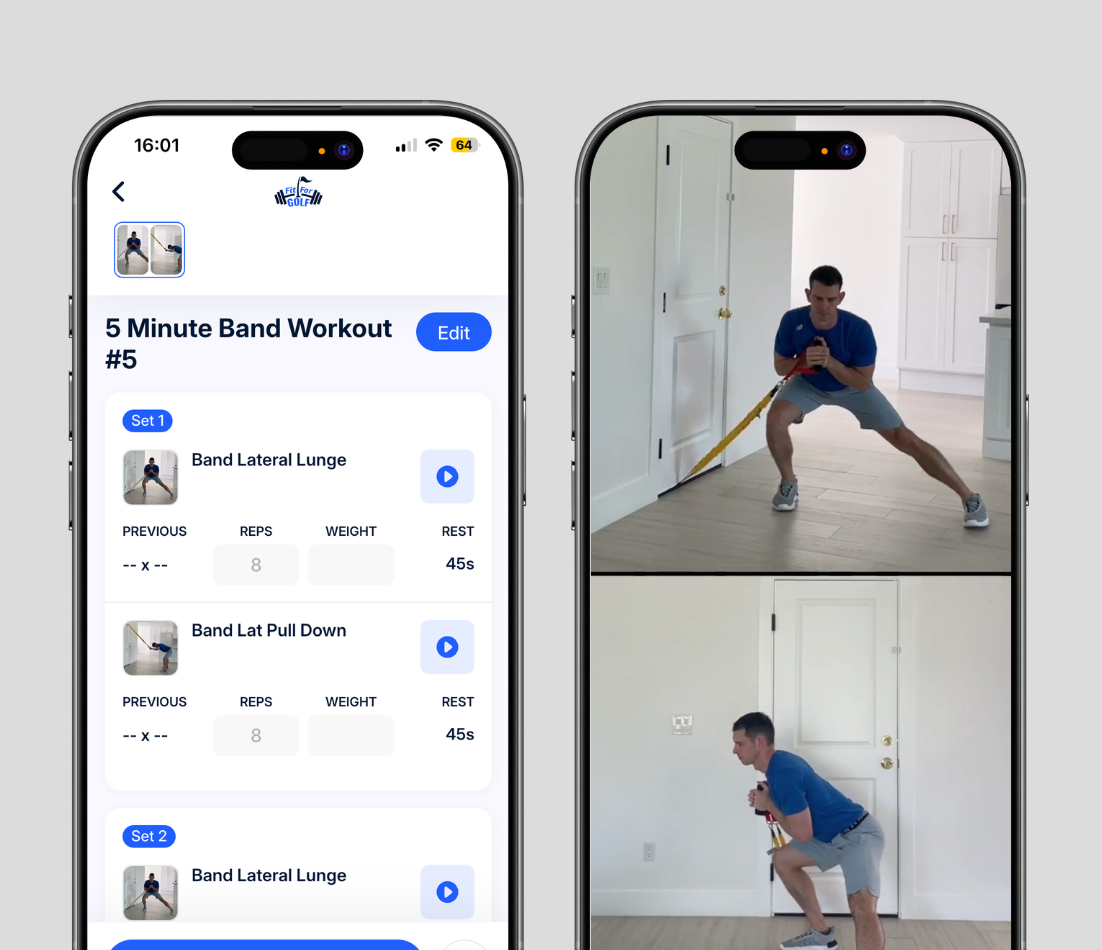
To help golfers stay on top of their muscle mass, strength, power, and speed, I created a periodised training year on the Fit For Golf App. There are 4 programs each of 12 weeks in duration, and set up perfectly to get you in incredible physical condition. Not just for golf and the potential to swing fast, but for life in general.
These are the Mass, Force, Velocity and In Season programs. This is also the order you follow them in. For more information check out the Fit For Golf App.
Takeaways
To quickly summarise here is how I broadly suggest organising training for maixmising club head speed over the long run:
Do a block of training focusing on making your fast twitch fibers bigger and stronger. Bigger fast twitch muscle fibers will allow you produce more force in explosive activities. This is primarily done with heavy resistance training. Keep the reps per set low, and don’t go all the way to failure, as this will help to minimise the negative effects on speed.
Make sure to include some power/ explosive exercises and speed training during this time, because you don’t want these abilities to detrain too much. The focus is on strength and hypertrophy however. The off season is a perfect time for this.
After a block of this type of training, generally about 8-12 weeks in duration, lay way off the heavy lifting, and transition into almost exclusively very high speed exercises. Jumps, throws, ballistic exercises, etc. This is the time to maximise your fast swinging / speed training.
Still do a tiny bit of heavy lifting as this will allow you to maintain your strength and muscle mass while not interfering with speed.
The pre / in season is perfect for this.
The idea here is to make your fast twitch muscle fibers bigger and stronger in the first block, then work on training these bigger and stronger fibers to get better at producing force at high speeds.
Once you get to the real meat of the season, you can do a little bit of everything, primarily to maintain (you might still make progress).
You can repeat these blocks year on year, trying to slightly improve in each block from year to year. Of course, you can adjust as necessary.
This rationale is what lead to the Mass, Force, Velocity, & In Season programs on the Fit For Golf App.
Train everything year round, but hugely shift the emphasis.
Gaining after the newbie / intermediate stage is hard, so you might need a lot of work on a particular quality. Maintenance is really easy, so you just need a tiny amount to not lose anything in a certain area.
I hope you enjoyed this article, let me know if you have questions.
Regards,
Mike