
Summarise & Save this Recipe on:
Summarise & Save this Recipe on:
The Traditional Easter Cake
Is there a more traditional Easter bake than a classic Simnel Cake?
Simnel Cake is often associated with Mother’s Day and Easter here in the UK. It’s packed with dried fruit, lightly spiced, and finished with that unmistakable layer of marzipan. In many ways, it’s quite similar to a traditional Christmas Cake and a Scottish Dundee Cake, but a little lighter in flavour and perfect for this time of year.
It’s a cake that has been around for centuries, but one that you don’t see quite as often these days. With quicker, easier options like Hot Cross Buns and Chocolate Easter Nests taking centre stage, Simnel Cake has somewhat fallen out of fashion. But if you were to ask me, it’s about time we tried to bring it back. Because it’s the kind of traditional cake that just feels a little bit special!
You’ll Need to be a Marzipan Fan
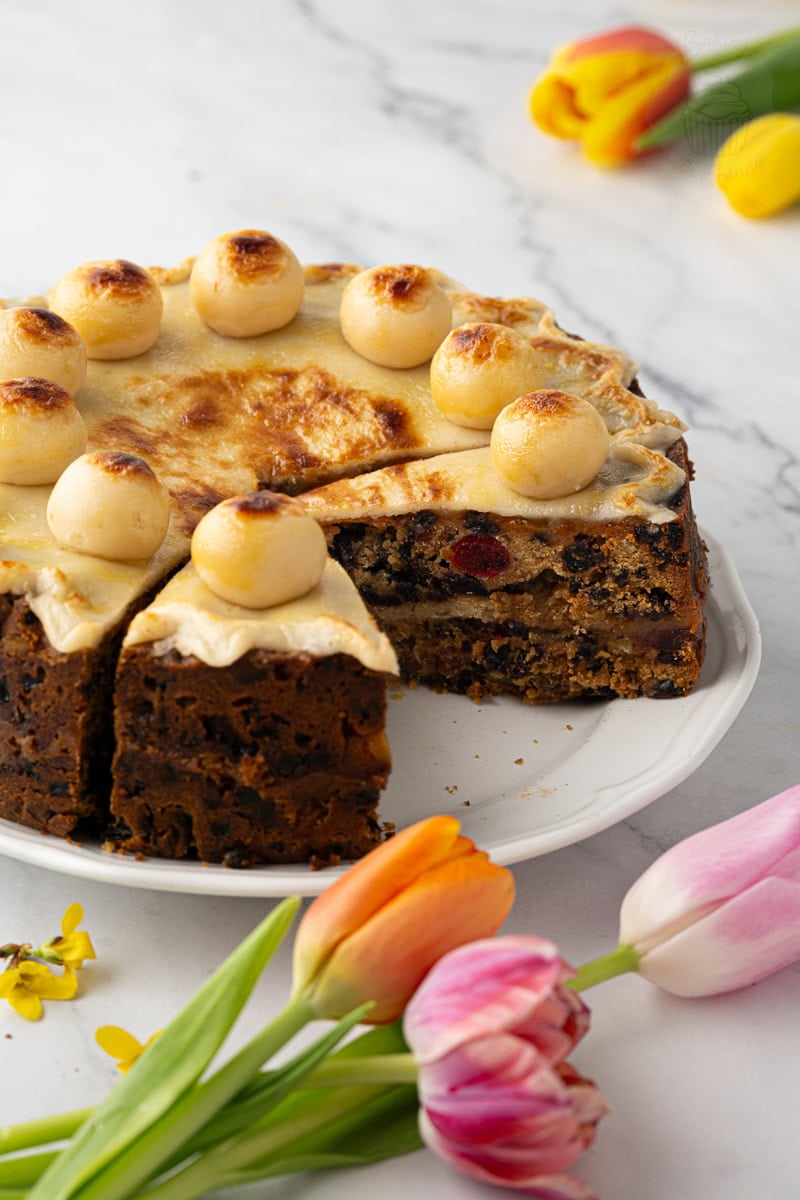
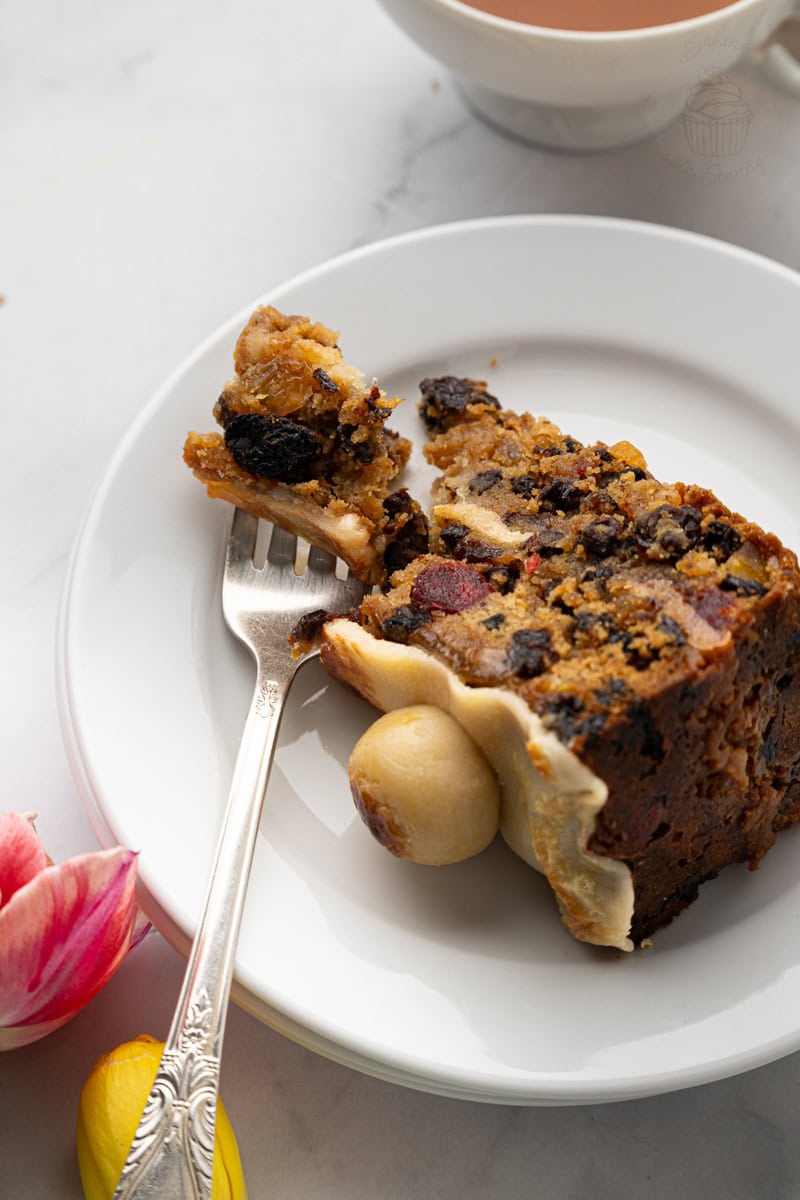
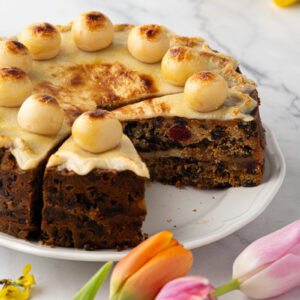
The layer of marzipan baked into the middle is what really sets a Simnel Cake apart from all other fruit cakes. It adds a lovely softness, as well as subtle almond flavour throughout, while the toasted marzipan on top gives you the classic finish that is instantly recognisable.
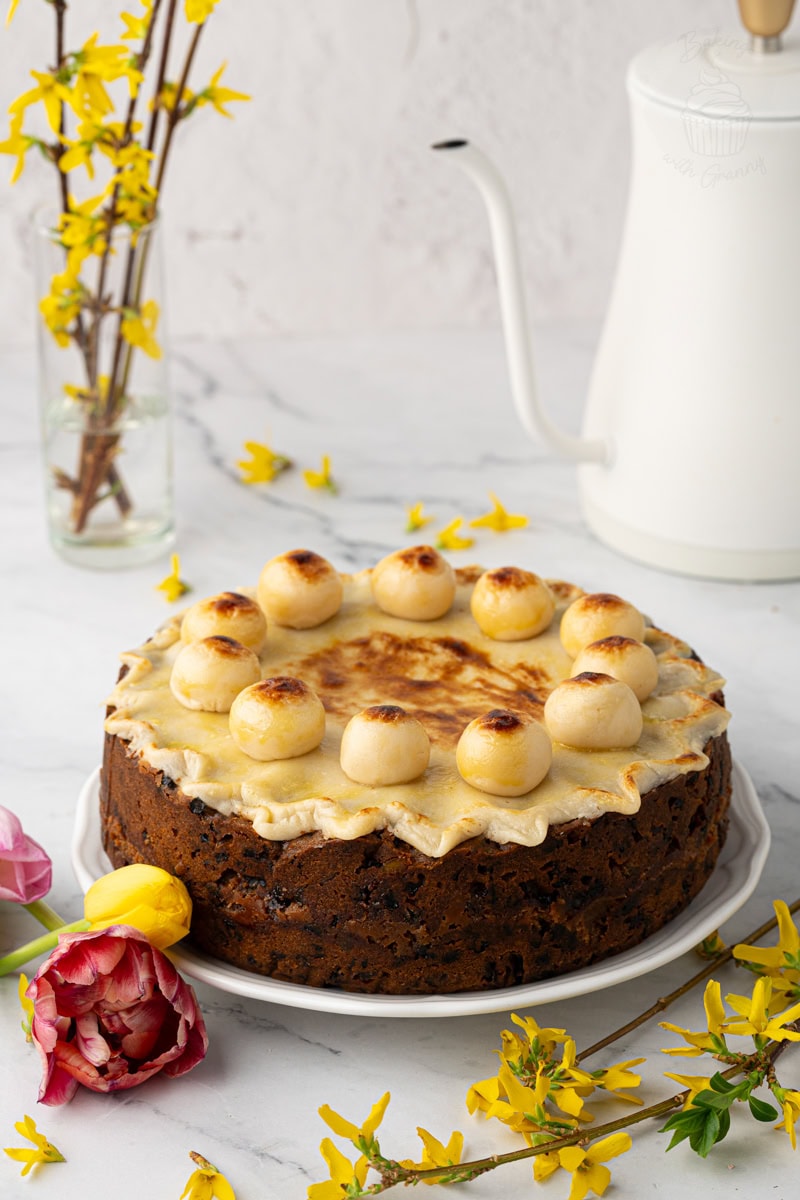
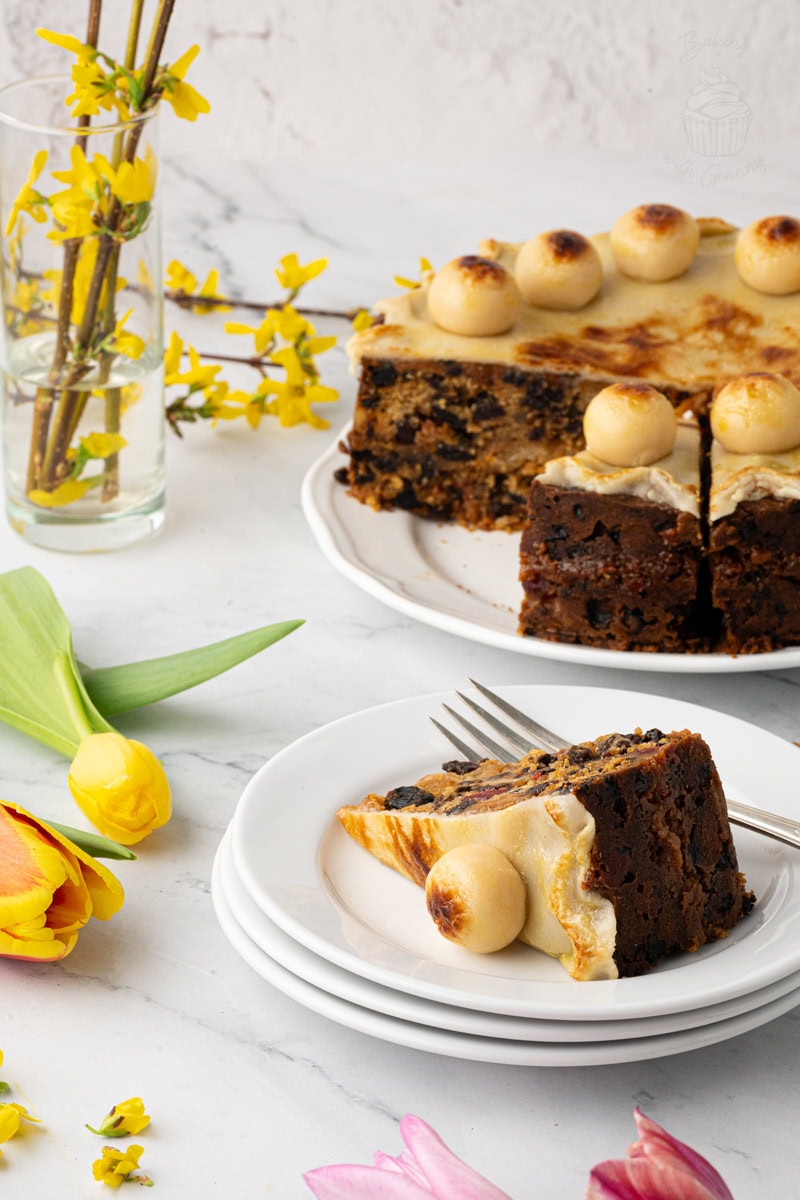
And of course, we can’t talk about Simnel Cake without mentioning the eleven marzipan balls. Traditionally, these represent the eleven apostles (leaving out Judas), giving the cake its strong connection to Easter and its long-standing place in British baking.
It might look impressive, but this is very much a home-baker-friendly recipe. It uses simple methods and everyday ingredients, and the result is a deliciously moist, flavour-packed cake that keeps well for days, even weeks – like any good fruit cake should.
And even if you’re not baking it for any religious reason, it still makes a lovely cake to celebrate the arrival of Spring – something a bit different from other Easter bakes, but just as delicious.
Tips for Easter Simnel Cake:
- Always Line Your Tin: This is a long, slow bake, so make sure your tin is properly lined with greaseproof paper to prevent the edges from catching, and to make sure the cake doesn’t get stuck to the tin.
- Room Temperature Ingredients: Let your butter/margarine and eggs come to room temperature before starting. This helps everything combine more evenly and gives a better texture overall.
- Coat the Fruit Well in the Batter: When mixing in your dried fruit, make sure it’s fully coated in the mixture. This helps prevent it from sinking during baking, and gives your cake the best texture.
- Create a Dip in the Top: Creating a wee dip in the top of the cake, with the back of a spoon, before baking helps stop the cake from doming too much – giving you a flatter surface for decorating later.
- Check the Cake While Baking: All ovens vary slightly, so start checking with a skewer near the end of the baking time. If needed, give it an extra 10 minutes at a time until done.
- Cool Before Decorating: Make sure the cake is fully cooled before adding the top marzipan layer. If it’s still warm, the marzipan can soften and slide around.
- Watch the Marzipan: When grilling the marzipan, keep a really close eye. It can go from golden to burnt very quickly!
With thanks to Naomi Seiler for creating these photos.
Simnel Cake FAQs
Simnel Cake is a traditional British fruit cake, usually made for Easter, featuring a layer of marzipan baked into the middle and another layer on top, and decorated with eleven marzipan balls.
The eleven marzipan balls traditionally represent the eleven loyal apostles, excluding Judas. Some people will do 12 balls to represent them all.
They are similar in that both are fruit cakes, but Simnel Cake is lighter, doesn’t usually contain alcohol, and includes marzipan baked into the middle and on top, too.
The cake is ready when a skewer inserted into the centre comes out clean. If needed, continue baking in 10-minute increments until done.
Yes, it actually benefits from being made ahead and given time to mature, as the flavours continue to develop over time.
Save this recipe!
Want to save this recipe for later? Pop your email below and come back to it when you’re ready to bake.
Simnel Cake
INGREDIENTS
- 175 g Soft Margarine (or Butter) (at room temperature)
- 175 g Soft Light Brown Sugar
- 3 Free-range Eggs (at room temperature; see Egg Size note below)
- 50 g Ground Almonds
- 200 g Plain Flour
- 1 tsp Mixed Spice
- 1 tsp Ground Cinnamon
- 350 g Currants
- 125 g Sultanas
- 125 g Raisins
- 75 g Glacé Cherries (halved)
- 50 g Dried Mixed Peel
- 1 Lemon (zested & juiced)
- 500 g Marzipan
- Apricot Jam
- 1 Beaten Egg for Glazing
EQUIPMENT
INSTRUCTIONS
- Preheat your oven to 150°C (130°C for fan-assisted ovens, Gas Mark 2 or 300°F). Grease and line a deep 20cm (8 inch) cake tin with greaseproof paper and set aside.
- In a large bowl, cream together your butter/margarine and sugar. Add your eggs, one at a time, ensuring each is mixed through before adding the next. Mix through your ground almonds.
- Sift in your flour, mixed spice, and cinnamon, then mix together to create a somewhat thick batter. Add all the dried fruit, lemon zest & juice, and mix until combined, and all the fruit is coated.
- Take half of the marzipan (approx 250g) and roll into a 20cm (8 inch) circle – use the base of your cake tin as a guide.
- Spoon half the cake mixture into your prepared tin, levelling the top and spreading to the edges, before placing the marzipan circle on top of the mixture.
- Add the remaining cake mixture on top of the marzipan, again levelling the top and spreading to the edges, then use a spoon to create a slight dip in the centre of the cake (this helps prevent it from rising into a dome).
- Bake for 2 hours, or until a skewer inserted comes out clean. If it needs a little longer, continue baking for a further 10 mins at a time, checking with a skewer until done.
- Remove your cake from the oven and allow it to cool completely in the tin. Once completely cool, remove the cake from the tin.
- Take the remaining marzipan and divide it into two. Roll one half into another 20cm (8-inch) circle, then shape the other half into 11 even-sized balls.
- Brush the top of the cake with apricot jam, then place the marzipan circle on top and pinch the edges for decoration, if desired.
- Brush the top of the marzipan with some beaten egg before placing the marzipan balls around the top edge of the cake. Brush the balls with some beaten egg before placing the cake under a hot grill for a few minutes to brown the marzipan to a nice, speckled golden brown (watch it closely as it will quickly burn).
- Allow the marzipan to cool down before serving.
IMPORTANT NOTE:
All my recipes are developed using a digital scale and the metric system (grams and millilitres). Cup measurements are available as a conversion, but these, unfortunately, won’t always be as accurate. For best results, I always recommend baking with a digital scale.
RECIPE NOTES:
Substitutions:
- Margarine: I usually use a soft baking margarine for cakes as I find it to be more predictable. But butter can be used instead, if you prefer – just make sure it is very soft before you start.
- Sugar: You can use dark brown sugar if you prefer. I like a light brown sugar in Simnel Cake, so it isn’t quite as rich as a Christmas Cake.
- Dried Fruit: You can use whatever combination of dried fruit you have or like – just make sure you make them up to the same total quantity.
- Lemon: You can swap the lemon for orange.











ABOUT THE AUTHOR
Amy Beth Reid
Amy Beth Reid is an award-winning food blogger, mother, wife and cookbook author. Inspired by her childhood in the kitchen with her Mum – a professional baker and her children’s Granny – Amy now shares her tried-and-tested traditional home baking recipes with bakers of all abilities around the world. She lives in Scotland with her husband, two sons and her small pack of Siberian huskies.